A Alumio vivid purple arrow pointing to the right, a visual representation of how to access more page material when clicking on it.
Go back

Optimize ROI with the Alumio iPaaS

By
Published on
September 19, 2022
Updated on
June 24, 2026
IN CONVERSATION WITH
Email icon
Email icon

Most modernizing businesses seek to digitalize and automate their business processes by integrating software solutions and cloud applications. While the traditional way to develop these integrations involves writing custom code, most companies are starting to use a next-gen integration solution called the iPaaS (integration Platform as a Service). The Alumio iPaaS is a cloud-based, integration platform that helps simplify how businesses develop and govern software integrations, with minimal IT support. While there are many cost optimization benefits of creating integrations with the Alumio iPaaS instead of with custom code, one of the key business benefits that it promises is a great increase in ROI (Return on Investment).

How the Alumio iPaaS helps increase business ROI

Thinking of creating your first software integrations or complex omnichannel experiences? Looking to upgrade or migrate old system integrations quickly? Considering integrating new software solutions and applications to improve digital growth?

The Alumio iPaaS (integration Platform as a Service) helps businesses hit the ground running with their digital transformation journey by providing a ready-to-use integration platform to fulfill all software integration needs. It helps them connect software solutions for business automation in a fast and flexible way. And, most importantly, at predictable prices.

“If you’re already automating your business with tools like: BitBucket, JIRA, HubSpot or other Project management tools, why write custom code to create system integrations when you can use an iPaaS?”

As a cloud-based, low-code integration platform, the Alumio iPaaS helps quickly and cost-effectively deploy and govern software integrations with automated tools and without custom coding. It helps businesses significantly optimize the cost and time it takes to develop and maintain these software integrations for digital transformation.

In this regard, the Alumio iPaaS makes it easier for businesses to effectively plan and calculate their ROI on integrations and digital growth, by helping them:

Save on creating an internal integration solution

One of the biggest business advantages of using the Alumio iPaaS is that it helps businesses skip the significant costs, time, and risks involved in developing and managing internal integration solutions.
Instead of investing expensive resources and many months to prepare a solution for creating integrations, the Alumio iPaaS enables businesses to start integrating software within weeks. As a result, businesses can already test and freely tweak their integrations to suit business needs better.
More importantly, this helps businesses avoid the hidden costs of maintaining, updating, and troubleshooting their own integration solution. It also prevents the unpredictable costs and hours their IT team or integration partner spends on all these processes, which often devours a business' ROI.  

Avoid spending on platform security, updates, and compliance

Apart from saving businesses the costs and hassles of developing and maintaining an internal integration solution, the Alumio iPaaS is constantly improved to meet evolving industry standards, in terms of performance and security. By providing regular platform and software updates, the highest levels of data security, scalable infrastructure, and cloud space, the Alumio iPaaS saves businesses from investing resources in constantly improving or expanding such features.

Additionally, the Alumio iPaaS also helps businesses stay compliant with key privacy legislations like GDPR, SOC2, CCPA, FERPA, HIPAA, and more. To adhere to these privacy regulations, businesses must be able to prove how they track and manage customer data. By centralizing all integrations on one platform, the Alumio iPaaS provides businesses with complete data control and access across all connected systems.

Get 360-degree data insights

Providing a centralized view of all integrations and data, the Alumio iPaaS helps businesses identify where they are losing money and what touchpoints need to be improved. This includes tracking overall customer engagement and identifying process inefficiencies. These insights can be used to optimize the targeting of marketing activities, ad spends, and budgets for business improvements.

Apart from helping businesses significantly increase their ROI, the Alumio iPaaS offers two other major cost optimization advantages. To discover more, please read:

However, if you’d like to read all the financial benefits that the Alumio iPaaS results in, download the whitepaper - ‘Cost Optimization Benefits of an iPaaS’.

Looking to experience first-hand how the Alumio iPaaS works and helps cost-optimize your business with software integrations? Click here to get a personalized demo by one of our integration specialists.

Turn AI ambition into action

Portrait of Leonie Becher Merli, Business Development Manager at Alumio

Get a free assessment of your integration needs and next steps

Portrait of Leonie Becher Merli, Business Development Manager at Alumio

No items found.
Topics in this blog:
No items found.

FAQ

Integration Platform-ipaas-slider-right
How does the Alumio iPaaS optimize ROI on digital integration investments?

Alumio optimizes ROI by reducing both the cost of integration (faster build time from prebuilt connectors, lower maintenance cost from config-based logic, reduced incident response overhead from centralized monitoring) and increasing the value of integration (real-time data flows that enable AI, personalization, and automation initiatives that batch-based custom integrations cannot support). The ROI improvement operates on both sides of the equation simultaneously: costs decrease through platform efficiency while the value of each connected system increases through better data availability and more reliable data flows.

Integration Platform-ipaas-slider-right
What are the measurable ROI components of switching from custom code to an iPaaS?

Measurable ROI components include: developer time savings (typically 40 to 60 percent reduction in integration build and maintenance time), incident response cost reduction (proactive monitoring versus reactive discovery), revenue protection from integration reliability improvements (fewer missed orders, inventory sync failures, or pricing discrepancies), and revenue enablement from faster time-to-market for new integrations (new channels or systems connected in weeks rather than months). Converting these to financial terms using actual developer rates, average order values, and time-to-market lag costs produces an ROI calculation specific to each organization's situation.

Integration Platform-ipaas-slider-right
How does the Alumio iPaaS reduce the cost of technical debt in integration landscapes?

Alumio reduces integration technical debt cost by replacing undocumented custom code with visible, configurable Routes that any trained team member can update. The ongoing maintenance cost of custom integrations grows with each system update that requires connector adjustments: in a large integration landscape, this maintenance can consume the majority of a developer's capacity. Alumio's platform-managed connector updates and config-based logic changes replace this with a predictable, lower-effort maintenance model. The transition may require upfront investment to migrate legacy connections, but the ongoing cost reduction compounds annually as the landscape grows.

Integration Platform-ipaas-slider-right
What is the relationship between integration quality and business revenue?

Integration quality directly affects revenue through: inventory accuracy (reliable inventory sync prevents the overselling that cancels revenue and damages customer relationships), order processing reliability (failed order integrations mean unfulfilled revenue), personalization quality (AI and marketing automation that depend on current integrated data produce higher conversion and retention), and time-to-market speed (faster integration of new channels and capabilities means capturing revenue opportunities that slower competitors miss). Each integration quality improvement has a revenue consequence that, when quantified, typically demonstrates ROI far exceeding the integration platform investment cost.

Integration Platform-ipaas-slider-right
How does Alumio help businesses quantify the ROI of integration investments?

Alumio helps businesses quantify integration ROI through platform metrics that map directly to business outcomes: Route success rate improvements (mapping to reduced order error rates), processing time reductions (mapping to faster fulfillment and lower operational cost), new system connection speed (mapping to time-to-market improvement), and developer time savings from the platform versus custom code. Alumio's Solutions Engineering team also provides ROI scoping support for prospective customers, helping quantify the expected value from specific integration use cases before investment decisions are made.

Integration Platform-ipaas-slider-right
What makes iPaaS a better long-term investment than custom integration development?

iPaaS is a better long-term investment because its value compounds over time while custom integration's cost compounds. Each new system connected to an iPaaS backbone benefits from the existing connector library, governance infrastructure, and platform expertise: reducing the per-integration cost as the landscape grows. Each new custom integration adds maintenance overhead, documentation debt, and knowledge concentration risk: increasing the per-integration cost as the landscape grows. The crossover point where iPaaS TCO is lower than custom development typically occurs within 12 to 18 months for organizations managing three or more active integrations.

Get a free assessment of your integration needs

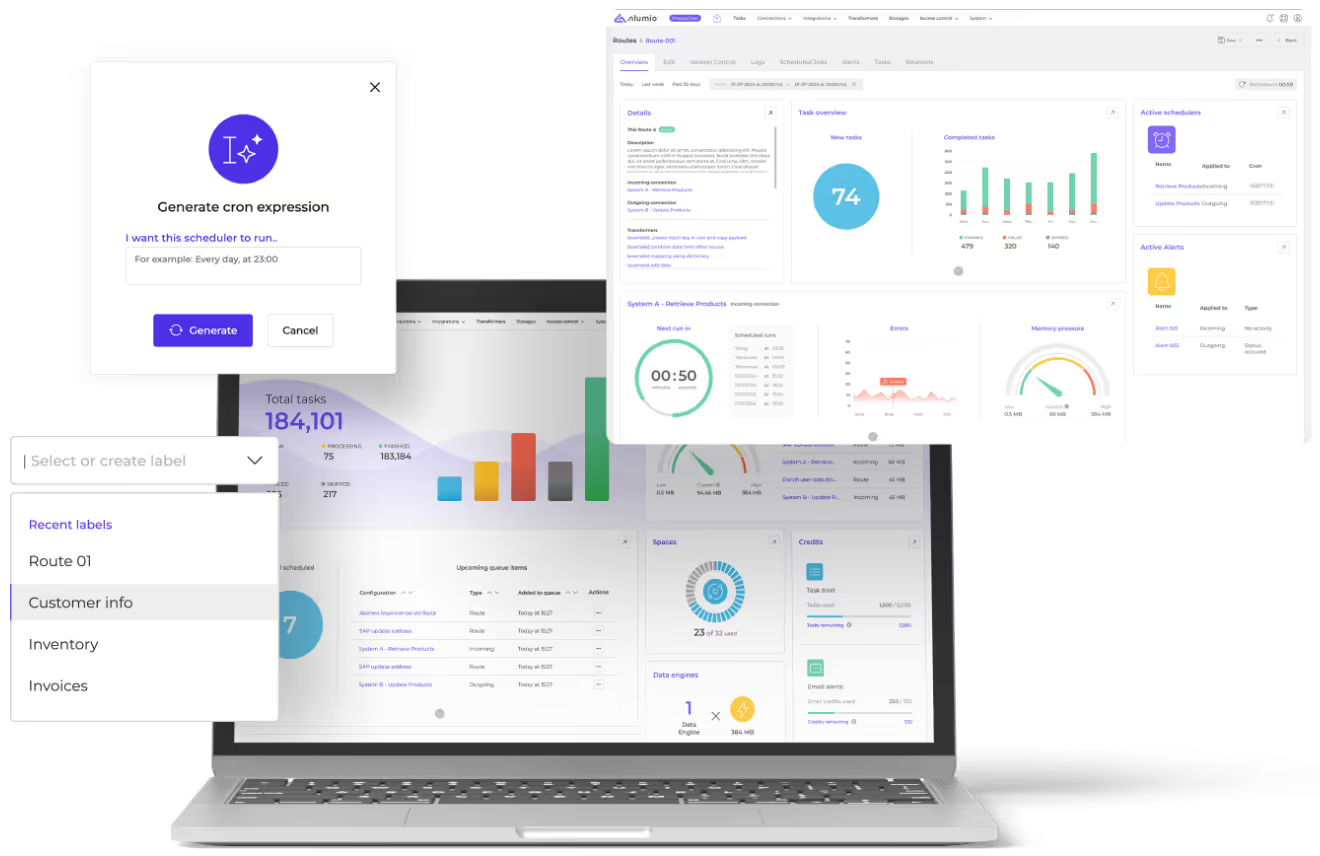
Laptop screen displaying the Alumio iPaaS dashboard, alongside pop-up windows for generating cron expressions, selecting labels and route overview.