

A Alumio vivid purple arrow pointing to the right, a visual representation of how to access more page material when clicking on it.
Go back

What is a Virtual Private Cloud (VPC)?

By
Saad Merchant
Published on
June 10, 2024
Updated on
June 24, 2026
IN CONVERSATION WITH
Email icon
Email icon

Cloud computing has revolutionized how modern businesses operate, offering unparalleled flexibility, scalability, and data security. Among the various cloud computing models, the Virtual Private Cloud (VPC) stands out as a powerful solution for organizations seeking enhanced security and control over their cloud environment. But what exactly is a VPC, and how does it differentiate itself from other cloud solutions like VPNs? In this comprehensive guide, we will delve into the concept of VPC, exploring how it works, its benefits, use cases, and why it is useful for your business to consider.

Understanding the need for a Virtual Private Cloud (VPC)

Modern enterprises seeking enhanced data security for sensitive data and more control over their cloud environment are benefiting greatly from implementing a VPC (Virtual Private Cloud) solution. Apart from ensuring data protection, a VPC also supports compliance with regulatory requirements, among a host of other benefits. As we delve into these other advantages of a VPC, let’s first explore how it works.

What is a Virtual Private Cloud (VPC)?

A Virtual Private Cloud, or VPC, is an isolated, secure portion of a shared public cloud that is designed to work exclusively as a private cloud for an enterprise. As a hybrid model of cloud computing, it combines public cloud and private benefits such as on-demand resources, scalability, and cost-effectiveness, along with a greater degree of control and security compared to a traditional multi-tenant public cloud.

Ideal for organizations with security-sensitive data, VPCs are favored by organizations in the healthcare, finance, government sectors, or large enterprises. It enables secure, isolated cloud environments that offer enhanced security, granular control, scalability, and seamless integration with on-premises systems, supporting hybrid cloud deployments and disaster recovery strategies.

The benefits of a Virtual Private Cloud

VPCs offer several advantages over traditional public cloud and private cloud deployments. Here's a breakdown of the key benefits:

1. Enhanced security

A VPC provides network-level isolation and robust security features such as encryption, access controls, and monitoring, ensuring sensitive data is well-protected.

2. Improved compliance

For businesses subject to strict data privacy regulations, VPCs can simplify compliance by facilitating control over data location and access.

3. Increased data control

VPCs empower you to manage your cloud environment with more granular control. You can define network configurations, security policies, and access rules tailored to your specific needs.

4. Customizable network configurations

With a VPC, businesses can define their own IP address ranges, subnets, route tables, and security rules, enabling granular control over their cloud environment.

5. Cost-efficiency

While offering a more secure environment, VPCs leverage the underlying cost-effectiveness of public cloud infrastructure, wherein businesses only pay for the resources they utilize.

7. Seamless hybrid cloud integration

VPCs facilitate the integration of on-premises systems with cloud resources through secure VPN connections, supporting hybrid cloud deployments and ensuring smooth business operations.


Speaking of VPCs employing VPN connections, it is important to clarify the differences between these two virtual solutions to avoid and clarify any incorrect correlations, which can be a common point of confusion.

What are the key differences between VPC vs. VPN?

While a Virtual Private Cloud (VPC) is an isolated, customizable, and highly secure virtual network environment within a public cloud, a Virtual Private Network (VPN) provides an encrypted internet connection that enables remote users to access a private network securely. A VPC is used for hosting applications, data storage, and cloud resources securely. Conversely, a VPN is essential for safeguarding data in transit and enabling secure remote access. A VPN does not offer the same level of network isolation and control over cloud resources as a VPC does within a cloud environment.

Here are some key distinctions between VPCs and VPNs:

  • Scope: VPC creates a dedicated, isolated network environment within the cloud, while a VPN encrypts data traveling over a public network.
  • Deployment: VPCs are cloud-based services offered by cloud providers. VPNs can be implemented on-premises or in the cloud.
  • Security: VPCs offer a more comprehensive security solution by isolating your entire cloud environment. VPNs primarily focus on securing data transmission.

How can businesses setup a Virtual Private Cloud?

To create a VPC, businesses typically need to specify the IP address range, subnet configuration, route tables, and security policies tailored to your organization's requirements A VPC can be seamlessly integrated with on-premises infrastructure using dedicated VPN connections or direct connect services provided by cloud service providers. A VPC enhances network security by providing isolated environments, robust access control mechanisms, encryption protocols, and monitoring tools to resolve potential security threats.

Determining the need for a Virtual Private Cloud

Virtual Private Clouds (VPCs) have emerged as a compelling solution for organizations seeking enhanced control over their cloud infrastructure. By combining the benefits of both public and private clouds, VPCs provide enhanced security, cost efficiency, and performance. Whether used for enterprise applications, hybrid cloud deployments, disaster recovery, or just development and testing, VPCs are an essential component of modern cloud computing strategies.

By providing a secure and isolated environment within a public cloud framework, VPCs empower businesses to optimize their operations while mitigating potential security risks. Whether you prioritize data security, regulatory compliance, or scalability, integrating a VPC into your business strategy can unlock a world of possibilities, propelling your organization towards greater efficiency and resilience in the digital age.


Turn AI ambition into action

Portrait of Leonie Becher Merli, Business Development Manager at Alumio

Get a free assessment of your integration needs and next steps

Portrait of Leonie Becher Merli, Business Development Manager at Alumio

No items found.
Topics in this blog:

FAQ

Integration Platform-ipaas-slider-right
What is a Virtual Private Cloud (VPC) and how does it benefit businesses?

A Virtual Private Cloud (VPC) is a logically isolated section of a public cloud provider's infrastructure (AWS, Azure, GCP) where an organization can run resources in a virtual network that it controls. Unlike standard public cloud deployments where resources are shared across all customers, a VPC provides network isolation, private IP addressing, and configurable security rules that allow organizations to create cloud environments with the privacy and control characteristics of private infrastructure: at cloud scalability. Businesses benefit from VPC through: enhanced security for sensitive workloads, compliance support for data residency requirements, and the ability to extend existing corporate network connectivity to cloud resources.

Integration Platform-ipaas-slider-right
How does VPC architecture improve data security for cloud applications?

VPC improves data security by: network isolation (resources within the VPC are not accessible from the public internet unless explicitly configured), security group controls (fine-grained rules governing which resources can communicate with which others, and which ports and protocols are allowed), private subnets (resources like databases can be placed in subnets with no public internet route, accessible only through the application tier), VPN or private connectivity to on-premise networks (enabling encrypted private communication between cloud and on-premise resources without public internet routing), and network traffic logging (flow logs that provide the audit trail of all network communications within the VPC).

Integration Platform-ipaas-slider-right
How does VPC connectivity relate to integration platform security?

VPC connectivity is relevant to integration platform security because integration platforms handle data flows between cloud-hosted business systems, and the security of those flows depends on how the network paths between systems are secured. When business-critical systems (ERP, e-commerce, WMS) run in VPCs, integration platforms should connect to them through secure, private network paths rather than through public internet endpoints where possible. For Alumio customers hosting their connected systems in VPCs, the integration platform's ability to communicate over VPN or private peering connections rather than public APIs provides an additional layer of network security for sensitive data flows.

Integration Platform-ipaas-slider-right
What cloud architecture patterns should businesses use when designing integration infrastructure?

Integration infrastructure best practices include: routing integration platform traffic through private endpoints rather than public internet where data sensitivity warrants it, placing database endpoints for connected systems in private subnets accessible only to application tier resources (never directly to the integration platform's public IP ranges), using VPN or AWS PrivateLink/Azure Private Link for connections between cloud-hosted integration infrastructure and on-premise systems, encrypting all API credentials and secrets using cloud provider secret management services (AWS Secrets Manager, Azure Key Vault), and applying the principle of least privilege to all network security group rules governing integration traffic.

Integration Platform-ipaas-slider-right
How do VPC configurations affect the deployment of integration platforms like Alumio?

VPC configurations affect integration platform deployment when connected systems are hosted in VPCs with private network requirements: the integration platform must be able to reach systems through the VPC's security rules, which may require IP allowlisting, VPN connectivity, or private endpoint configurations. For Alumio cloud customers, the platform runs in Alumio's managed infrastructure and connects to customer systems through their public API endpoints: requiring customer systems' security groups to allowlist Alumio's IP ranges. For customers with strict private connectivity requirements, consultation with Alumio's security team on the appropriate network configuration ensures integration flows meet the organization's security architecture requirements.

Integration Platform-ipaas-slider-right
What is the relationship between cloud security architecture and data compliance?

Cloud security architecture and data compliance are directly linked: many compliance frameworks (GDPR, HIPAA, PCI DSS, ISO 27001) have specific requirements for how data must be protected in cloud environments: encryption in transit and at rest, network isolation, access logging, and geographic data residency. VPC architecture is one of the primary technical controls that makes cloud-hosted systems compliant with these requirements: private subnets prevent unauthorized access, security groups enforce least-privilege network access, and flow logs provide the audit trail for network activity that compliance frameworks require. Organizations designing cloud-hosted integration infrastructure should include VPC security requirements in their architecture decisions to ensure integration flows meet the compliance standards applicable to the data they carry.

Get a free assessment of your integration needs

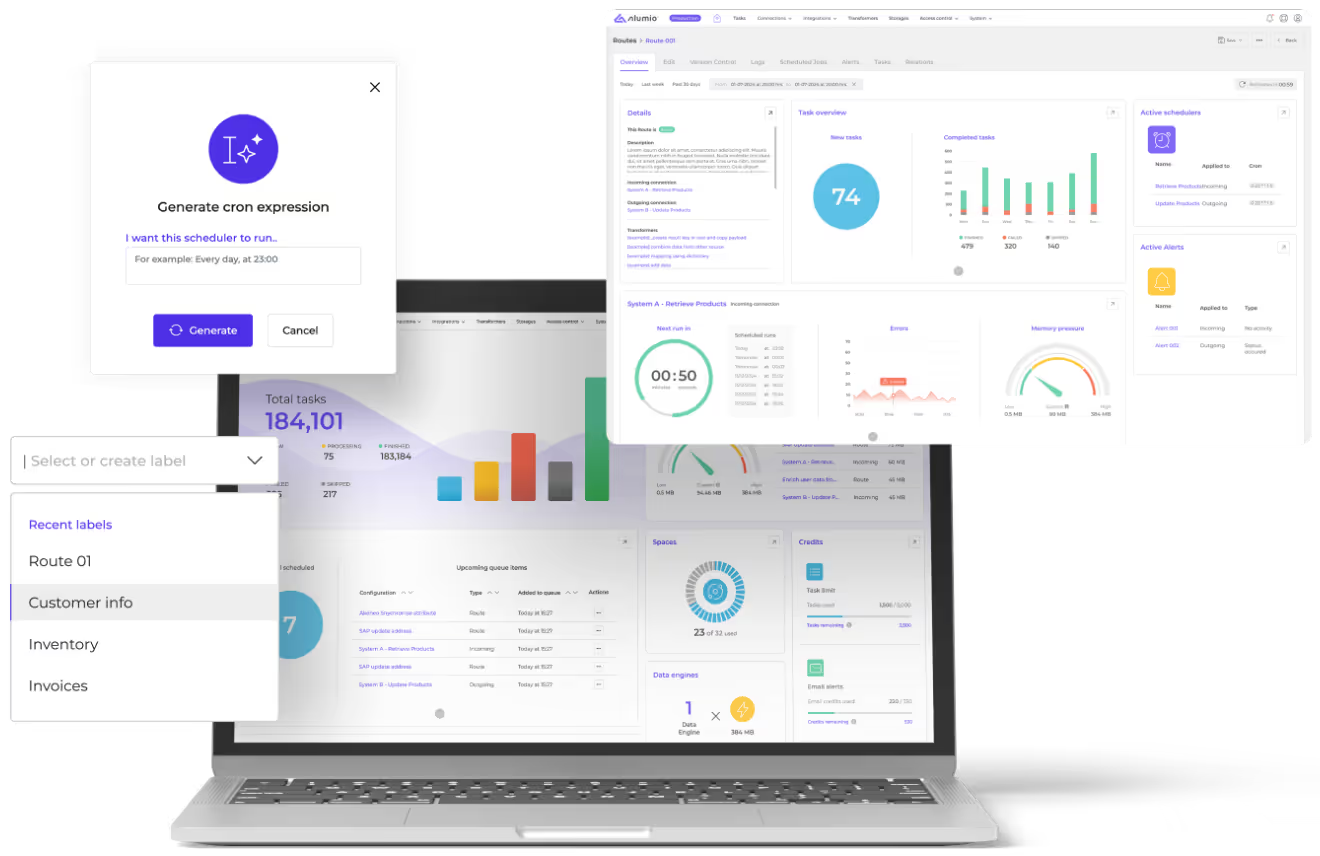
Laptop screen displaying the Alumio iPaaS dashboard, alongside pop-up windows for generating cron expressions, selecting labels and route overview.