A Alumio vivid purple arrow pointing to the right, a visual representation of how to access more page material when clicking on it.
Go back

Two-way order sync between Magento and RealtimeWMS

By
Published on
May 13, 2020
Updated on
June 24, 2026
IN CONVERSATION WITH
Email icon
Email icon

In today's fast-paced e-commerce landscape, efficient order management is crucial for delivering exceptional customer experiences. The Alumio iPaaS (integration Platform as a Service) is a next-gen, API-driven middleware solution that helps seamlessly integrate e-commerce platforms like Magento (now known as Adobe Commerce) with third-party tools like the RealtimeWMS, enabling real-time order synchronization. This blog will explore how the Alumio iPaaS simplifies two-way sync between Magento & RealtimeWMS, streamlines operations, and drives business growth.

Enabling two-way order sync with Alumio iPaaS - for Magento & RealtimeWMS

The Alumio iPaaS acts as a centralized hub for integrating your e-commece store (Magento - in thise case) and other essential applications like the RealtimeWMS warehouse management system, making it easier to manage end processes data across both platforms. As a cloud-native, low-code integration solution, Alumio integrates applications via their APIs, enables workflow automation, flexible data transformation, and synchronous and asynchronous data exchange.

Integrating Magento and RealtimeWMS via the Alumio iPaaS, allows businesses to customize how they went both applications to exchange data. This includes two-way order sync, which is essential to provide customers with up-to-date order information and establish a smooth sailing warehouse management process.

What is two-way order sync between Magento & RealtimeWMS?

Two-way order sync refers to the bi-directional exchange of data between two systems—in this case, your Magento store and RealtimeWMS. Enabling two-way order sync ensures that all orders in the e-commerce platform are instantly shared with the WMS for quick processing and order fulfillment. At the same time, any updates made in RealtimeWMS, such as changes in stock adjustments or shipment confirmations, are immediately updated in Magento, ensuring accurate data availability. As orders are fulfilled, shipment information is sent back to Magento, keeping customers informed in real time.

The benefits of two-way order sync

A two-way order sync between Magento and RealtimeWMS ensures that order information is consistently updated across both systems. This eliminates manual data entry, reduces errors, and streamlines inventory management. Key benefits include:

  • Real-time order visibility: Stay informed about the status of orders from creation to fulfillment.
  • Faster fulfillment: Real-time data exchange between systems speeds up order processing and fulfillment.
  • Improved accuracy: Minimize discrepancies between sales data and inventory levels.
  • Enhanced efficiency: Automate order processing and reduce manual intervention.
  • Better customer satisfaction: Deliver timely order updates and accurate shipping information

Turn AI ambition into action

Portrait of Leonie Becher Merli, Business Development Manager at Alumio

Get a free assessment of your integration needs and next steps

Portrait of Leonie Becher Merli, Business Development Manager at Alumio

How the Alumio iPaaS facilitates two-way order sync

The Alumio iPaaS provides a robust and scalable platform for integrating Magento and RealtimeWMS. Here's how it works:

  1. API connectivity: The Alumio iPaaS leverages APIs to securely connect Magento and RealtimeWMS, enabling seamless data exchange.
  2. Data Mapping: Configure the mapping between fields in Magento and RealtimeWMS to ensure accurate data transfer.
  3. Real-time synchronization: The Alumio iPaaS continuously monitors for changes in order status, product availability, and other relevant data. New updates are automatically synchronized between both systems.
  4. Error handling: Built-in error handling mechanisms identify and address any issues that may arise during the synchronization process, ensuring data integrity.
  5. Scalability: The platform can handle increasing order volumes and complex business processes, ensuring that the two-way order sync can freely grow in complexity.

This two-way order sync between Magento and RealtimeWMS orchestrated via Alumio automates several key processes. It consists of a Route for Orders that publishes orders that are placed within Magento to RealtimeWMS. At the same time, stock and shipments are published from RealtimeWMS to Magento. All routes are synced in both realtime and at specific timings to comply with the standards both systems require. RealtimeWMS enables Alumio to make use of web hooks, allowing an optimal way of syncing data. The transformation of data that goes in and out of Alumio was needed to make sure the data of the entities matches the integrated system’s specifications.

Enabling real-time e-commerce with two-way order sync

For e-commerce businesses that integrate their e-commerce platform with third-party tools and applications like WMS systems, the ability to synchronize orders in both directions is a game changer. The Alumio iPaaS empowers companies with automated, customizable, and scalable solutions for managing their order workflows. By automating data exchange and eliminating manual processes, businesses can improve operational efficiency, reduce errors, and deliver exceptional customer experiences. What's more, if you're looking to expand your e-commerce landscape, the Alumio iPaaS makes it simple to seamlessly connect more applications and SaaS to existing integrations.

No items found.
Topics in this blog:
No items found.

FAQ

Integration Platform-ipaas-slider-right
What is two-way order synchronization between Magento and a WMS?

Two-way order synchronization means orders flow from Magento to the WMS for picking, packing, and shipping, and fulfillment and shipping confirmations flow back from the WMS to Magento to update order status and tracking information. Without this bidirectional sync, warehouse teams work from a separate system while the Magento storefront shows stale order statuses, requiring manual updates or customer service intervention for every order query.

Integration Platform-ipaas-slider-right
How does Alumio enable two-way sync between Magento and RealtimeWMS?

Alumio acts as the integration backbone between Magento and RealtimeWMS, managing bidirectional data flows via both systems' APIs. When an order is placed in Magento, Alumio routes the order data to RealtimeWMS for fulfillment processing. When RealtimeWMS confirms shipment, Alumio routes the fulfillment and tracking data back to Magento to update order status automatically. All data exchanges are logged and monitored, with failed records flagged for retry rather than silently dropped.

Integration Platform-ipaas-slider-right
What data flows between Magento and a WMS in a two-way integration?

The outbound flow from Magento to the WMS includes order details: line items, quantities, shipping address, delivery method, and any order-level instructions. The inbound flow from the WMS back to Magento includes shipment confirmations, tracking numbers, partial fulfillment updates, and stock level adjustments. Some integrations also include product and SKU data flowing from Magento to the WMS so the warehouse catalog stays synchronized with the storefront.

Integration Platform-ipaas-slider-right
Why is real-time order synchronization important for WMS integration?

Real-time synchronization means warehouse teams receive new orders within seconds of confirmation rather than waiting for a batch run, shortening the time between order placement and picking start. It also means tracking information reaches Magento and the customer as soon as it is available in the WMS, reducing customer service contacts about order status. For high-volume operations, even a short batch delay multiplies across thousands of daily orders into meaningful fulfillment lead time that customers notice.

Integration Platform-ipaas-slider-right
What are the most common problems in Magento to WMS order sync integrations?

The most common problems are: order data format mismatches, timing issues where orders sync before payment is confirmed, partial fulfillment handling (orders shipped in multiple batches need the WMS to send updates per shipment), and error handling gaps where a failed sync is not surfaced until a customer calls about a missing delivery. An integration platform that logs every exchange and surfaces failures in real time addresses these systematically rather than reactively.

Integration Platform-ipaas-slider-right
When should a Magento business invest in an integration platform for WMS connectivity?

The right time to invest in an integration platform for Magento-to-WMS connectivity is when order volume makes manual or file-based synchronization unsustainable, when fulfillment errors caused by data sync failures are increasing, or when the WMS integration is one of several systems (ERP, PIM, marketplaces) that all need to connect to Magento. Alumio manages all of these connections in one governed environment, so adding a WMS integration does not require a separate custom connector alongside the existing landscape.

Get a free assessment of your integration needs

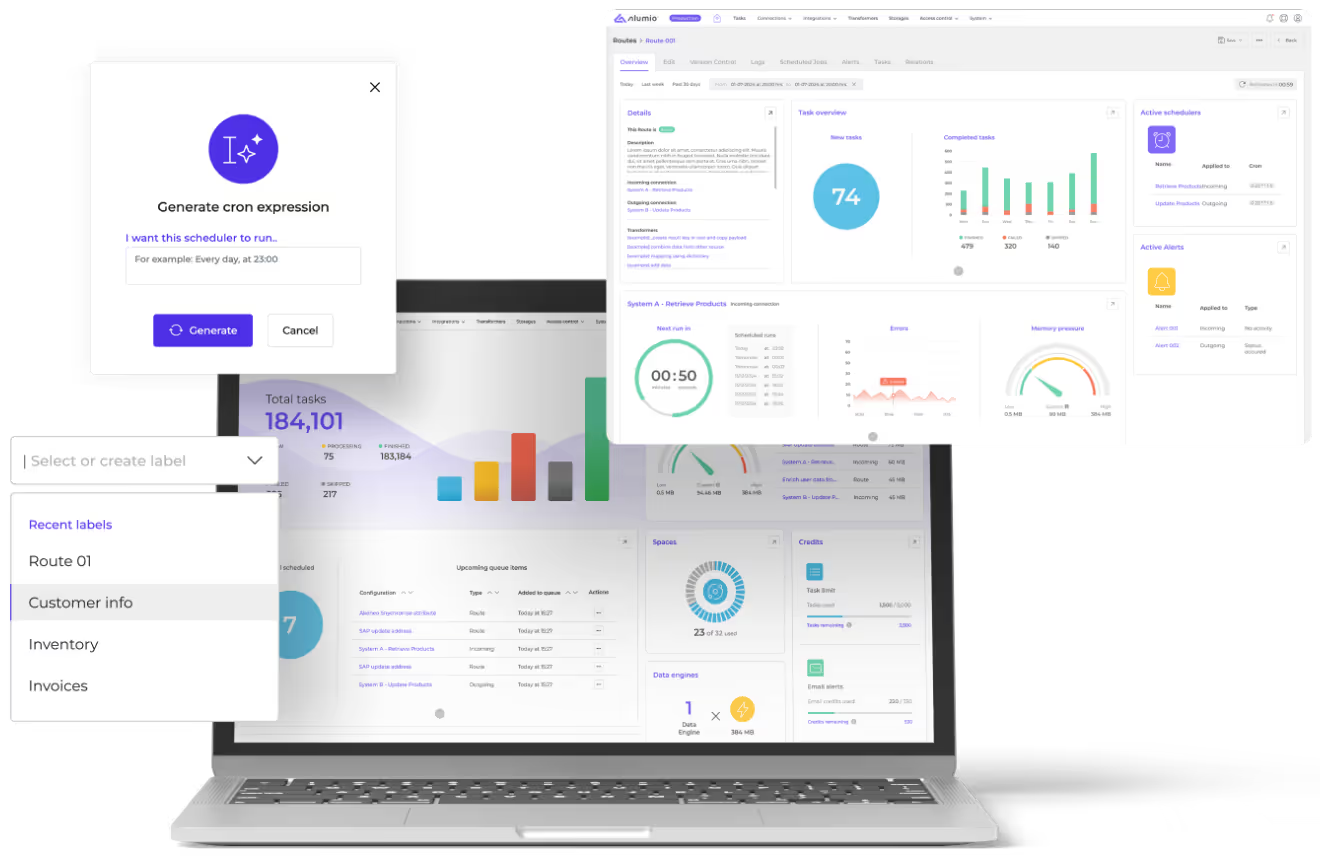
Laptop screen displaying the Alumio iPaaS dashboard, alongside pop-up windows for generating cron expressions, selecting labels and route overview.