


Integrate popular e-commerce apps 3X faster

Connect now
A Alumio vivid purple arrow pointing to the right, a visual representation of how to access more page material when clicking on it.
Go back

Top 10 e-commerce trends shaping digital commerce in 2026

By
Saad Merchant
Published on
February 13, 2026
Updated on
February 16, 2026
IN CONVERSATION WITH
Email icon
Email icon

E-commerce in 2026 is shaped by structural change rather than surface innovation. AI-driven discovery, unified retail models, regulatory reporting requirements, and real-time personalization are redefining how digital commerce systems must operate. For technology leaders, success depends less on adding new tools and more on building an integration architecture that supports automation, maintains data integrity, and scales without increasing operational risk.

What are the top 10 e-commerce trends in 2026 & beyond?

Digital commerce in 2026 is being reshaped by intelligent automation, unified operations, regulatory data demands, and AI-driven discovery. For CTOs, the real challenge is not adopting new tools, but building an integration architecture that connects systems reliably, absorbs change without disruption, and supports scalable growth across increasingly complex ecosystems.

The following ten trends represent the most significant structural shifts influencing commerce infrastructure in 2026 and beyond.

1. Agentic commerce reshapes product discovery

AI assistants are evolving from search enhancers into autonomous purchasing agents. Consumers increasingly delegate product discovery and even transaction execution to AI systems rather than navigating storefronts manually.

For commerce platforms, this means optimizing for machine-driven discovery. Product data must be structured, enriched, and exposed through secure APIs, while inventory and pricing endpoints must be accessible in real time. This shifts focus from optimizing user interfaces to ensuring backend systems are intelligible to AI agents. Integration platforms play a central role by managing API exposure, data transformation, and orchestration across PIM, ERP, and commerce layers.

Emerging standards such as the Model Context Protocol (MCP) are accelerating this shift by defining how AI agents interact with business systems. As explored in our blog on MCP and the future of AI integrations, integration layers will play a critical role in securely orchestrating these AI-to-system interactions.

2. Hyper-personalization becomes real-time and predictive

Personalization has moved beyond segmentation into continuous behavioral adaptation. Promotions, search results, and storefront layouts adjust dynamically based on user signals and historical data.

This requires real-time synchronization between CRM, commerce platforms, CDPs, and marketing automation systems. Latency, duplicate records, or inconsistent profiles weaken personalization accuracy.

Scalable personalization depends on maintaining unified customer profiles and synchronized data flows across systems. Without structured integration, personalization initiatives remain fragmented.

3. Composable commerce becomes operational standard

Enterprises continue shifting away from monolithic platforms toward modular commerce stacks built from best-of-breed services.

Composable architecture increases agility but multiplies integration dependencies. Search engines, CMS platforms, checkout providers, and payment services must operate cohesively.

The viability of composable commerce depends on a centralized integration layer that governs data mapping, workflow orchestration, and system abstraction. Without this, composability increases complexity instead of flexibility.

4. Unified commerce replaces channel-based operations

Unified commerce moves beyond omnichannel by centralizing backend logic across online stores, mobile apps, marketplaces, and physical retail.

Inventory, pricing, promotions, and customer history must remain synchronized across all touchpoints. A disconnected POS and ERP environment leads to overselling, inconsistent pricing, and fragmented reporting.

The technical requirement is continuous synchronization between ERP, OMS, POS, and commerce platforms. Unified retail is not a frontend strategy; it is an integration discipline.

5. Sustainability and regulatory reporting become data obligations

Environmental reporting is no longer optional. Regulations such as Extended Producer Responsibility frameworks and climate disclosure laws require auditable sustainability data.

Carbon metrics, material sourcing, and packaging information must be collected from suppliers, manufacturing systems, and logistics providers.

Manual reporting processes cannot scale. Compliance becomes an integration challenge that requires automated aggregation, normalization, and reporting across systems and partners.


Turn AI ambition into action

Portrait of Leonie Becher Merli, Business Development Manager at Alumio

Get a free demo of the Alumio platform

Portrait of Leonie Becher Merli, Business Development Manager at Alumio

Want to leverage an integration platform to adopt these AI trends?

Want to leverage an integration platform to adopt these AI trends?

6. Social commerce drives real-time operational pressure

Marketplaces and social platforms continue merging with commerce. Viral events, influencer campaigns, and live shopping create unpredictable demand spikes.

Backend systems must absorb rapid order influx without breaking inventory accuracy or fulfillment processes.

Real-time order ingestion, automated inventory updates, and marketplace synchronization are essential to prevent overselling and reconciliation backlogs.

7. AI search overviews change SEO dynamics

Search engines increasingly deliver AI-generated answers directly in results pages. Visibility now depends on structured data quality rather than traditional keyword ranking alone.

Product attributes, pricing, availability, and reviews must be consistently structured and machine-readable.

Data quality becomes a competitive advantage. Inconsistent or fragmented product data reduces AI visibility and organic reach.

8. B2B commerce demands consumer-grade UX

B2B buyers expect intuitive portals, self-service ordering, and personalized pricing while still requiring contract terms, approval workflows, and negotiated price lists.

Delivering this experience requires deep ERP integration to manage credit limits, contract pricing, and customer hierarchies in real time.

The complexity is backend-driven. A smooth B2B frontend depends on structured bidirectional synchronization with ERP and financial systems.

9. Voice and conversational commerce mature

Voice interfaces and conversational AI require enriched product data and semantic clarity. Customers expect systems to interpret nuanced queries.

This increases the importance of detailed product attributes, taxonomy consistency, and structured metadata.

Commerce stacks must support granular data mapping and synchronization across PIM and storefront systems to remain discoverable in conversational environments.

10. Intelligent operations and automated security gain priority

As SaaS ecosystems expand, operational security becomes more complex. Access control, user provisioning, and audit requirements grow alongside system count.

Manual offboarding and access revocation processes create compliance risks.

Integration platforms can automate identity-driven workflows, ensuring access is granted and revoked consistently across connected systems, reducing security exposure.

Integration architecture is the defining capability for 2026

The most significant e-commerce trends in 2026 share a common requirement: seamless, governed connectivity across systems.

Agentic commerce depends on structured APIs. Hyper-personalization requires real-time synchronization. Unified retail demands ERP-to-POS integration. Sustainability reporting requires automated data aggregation. Composable commerce requires system abstraction.

These are not feature challenges. They are integration challenges.

For CTOs, the strategic priority is not simply selecting best-of-breed applications. It is building an integration architecture that centralizes orchestration, standardizes data mapping, and maintains governance as ecosystems expand.

An integration platform like Alumio provides this backbone by connecting CRM, ERP, PIM, marketplaces, commerce engines, and operational systems within a controlled framework. Instead of increasing complexity with every new tool, organizations can absorb change predictably.

In 2026, competitive advantage will not be defined by the number of tools in your stack, but by how effectively they work together.

No items found.

FAQ

Integration Platform-ipaas-slider-right
What is agentic commerce and how does it affect my online store?

Agentic commerce refers to the use of autonomous AI agents that perform shopping tasks on behalf of users. These agents can research products, compare prices, and even execute purchases. For online stores, this means your product data must be highly structured and machine-readable (via APIs) so these agents can easily find and interpret your offerings.

Integration Platform-ipaas-slider-right
Why is unified commerce better than omnichannel?

While omnichannel focuses on having a presence on multiple channels, unified commerce focuses on connecting them through a single backend system. Unified commerce eliminates data silos, ensuring that inventory, pricing, and customer data are identical whether a customer is shopping on a mobile app, a website, or in a physical store. It provides a more consistent and reliable customer experience.

Integration Platform-ipaas-slider-right
How can I prepare my e-commerce business for AI-driven personalization?

To prepare for AI-driven personalization, you must break down data silos. Your personalization engines need access to real-time data from your ERP, CRM, and e-commerce platform. Investing in an integration platform (iPaaS) is often the first step, as it allows you to centralize customer data and feed it into your AI tools instantly.

Integration Platform-ipaas-slider-right
Is composable commerce suitable for small businesses?

Composable commerce is typically more beneficial for mid-market and enterprise businesses with complex requirements that outgrow all-in-one platforms. However, smaller businesses can adopt elements of composable commerce (like adding a specialized search tool) as they scale. The key is ensuring you have the technical resources or integration tools to manage the connections between different components.

Integration Platform-ipaas-slider-right
What are the key sustainability regulations impacting e-commerce in 2026?

Key regulations include the EU's Digital Product Passport (DPP), Extended Producer Responsibility (EPR) laws in the UK and Europe, and emerging climate disclosure laws in US states like California (SB-253). These require businesses to track and report detailed data on their supply chain emissions and material sourcing.

Integration Platform-ipaas-slider-right
Why is integration architecture critical for future-proof e-commerce growth?

Most 2026 e-commerce trends—agentic commerce, real-time personalization, unified retail, sustainability reporting, and composable stacks—depend on reliable system connectivity. Without a structured integration architecture, adding new channels or tools increases technical debt and operational risk. An integration platform centralizes data mapping, workflow orchestration, and monitoring, allowing businesses to scale without repeatedly rebuilding connections or destabilizing core systems.

Want to see Alumio in action?

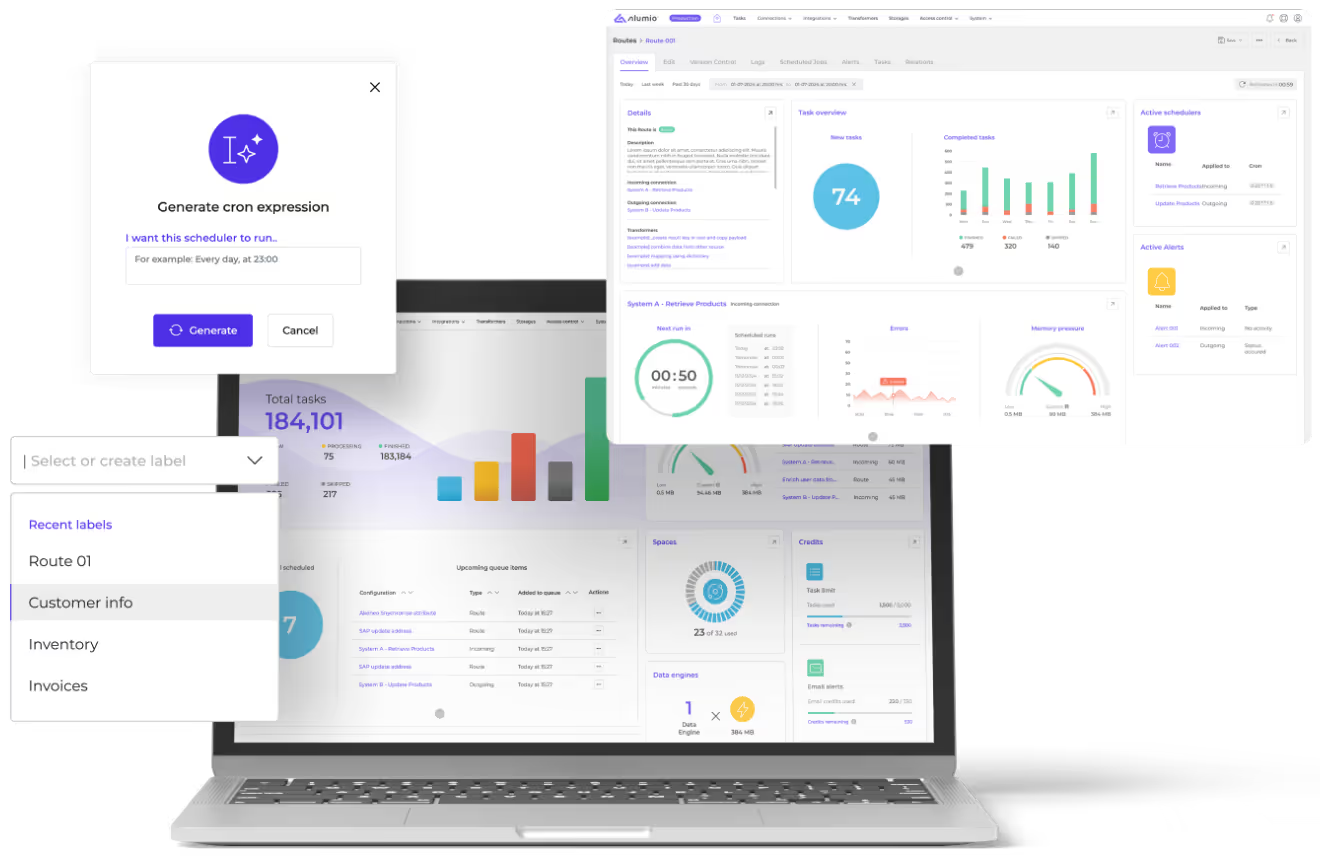
Laptop screen displaying the Alumio iPaaS dashboard, alongside pop-up windows for generating cron expressions, selecting labels and route overview.