




.svg)



Scalable integration architecture starts with one connection and grows into a backbone
Most integration journeys follow the same pattern. The business starts with one critical connection between two systems, builds it well, and gets real value from it. Then the next connection arrives, then the next. By the time the business is running five or ten integrations, the original architecture that worked for one is creaking under the load. The question isn't whether to evolve the architecture, but how to evolve it deliberately.
That deliberate evolution is what scalable integration architecture services deliver. They take the early integration wins and turn them into a foundation that supports the next twenty or fifty connections without breaking. The integration platform is the technical backbone, but the architecture is the broader pattern of how systems connect, how data flows, and how governance and observability get layered in over time. Businesses that treat integration as architecture from the second or third connection forward end up with a backbone, while those that keep treating each new integration as a separate project end up with technical debt.
Why does the first integration always look like enough?
The first integration always looks like enough because it solves the immediate problem and the cost of building it properly looks disproportionate. A team building its first ERP-to-commerce connection needs to move orders and stock. That can be done with a custom script in two weeks, and once it works, the team moves on to the next priority.
The decision rarely feels wrong at the time. The custom script does what it needs to, and the team has other priorities lined up. With no second integration on the immediate roadmap, investing in shared architecture would look like overkill for a one-off connection. Every business goes through this exact reasoning on its first integration.
What goes wrong isn't the first integration but the second, third, and fourth. They get built the same way, by different developers on different schedules, each one solving its immediate problem without being designed to interoperate with the others. By the time the business notices, the architecture has become a pile of independent connections held together by tribal knowledge rather than design.
The three stages of integration architecture maturity
Integration architecture matures in three recognizable stages: lite, core, and backbone. Each stage represents a different relationship between the business and its integrations. Most businesses pass through all three, but they pass through them at different speeds and with different levels of intention.
Lite is the first stage, with one or two integrations, usually point-to-point, built by individual developers or vendors. These integrations are functional but not architectural. Documentation is informal, monitoring is ad hoc, and the team that built the integration is the team that knows how it works.
Core is the second stage, where the integration count grows to five or fifteen and the business starts to recognize patterns across them. Common transformations, shared authentication, and similar error-handling needs appear repeatedly. A platform decision usually happens at this point: the business either consolidates onto an integration platform or builds an internal abstraction layer. This is where integration as architecture starts to be a real category rather than a label.
Backbone is the third stage, where integration is treated as core infrastructure with a dedicated team or function, formal governance, observability, audit trails, and built-in scaling patterns. New integrations get built on the foundation rather than alongside it. The business treats the integration layer as architecture in the same way it treats its database, network, or identity layers as architecture.
What changes between lite, core, and backbone integration?
Three things change between the stages: ownership, governance, and reusability. Lite integrations are owned by whoever built them, with little formal governance and almost no reusability. Core integrations introduce some platform-level ownership and shared patterns. Backbone integrations are owned by a dedicated function with full governance, reusable components, and architectural standards.
Ownership shifts from individual contributors to a dedicated function. In lite, the developer who built the connection is the de facto owner. In core, a platform team takes responsibility for the integration layer. In backbone, integration is a named architecture function with its own headcount, roadmap, and accountability.
Governance shifts from informal to formal. Lite integrations might not be documented at all. Core integrations have basic monitoring and error handling. Backbone integrations have audit trails, change management, access controls, and SLA-tracked uptime.
Reusability shifts from zero to high. Lite integrations are bespoke per connection. Core integrations start sharing transformation logic and connectors. Backbone integrations have reusable patterns, templated connectors, and architectural standards that new integrations slot into. The cost of adding the twentieth integration is dramatically lower than the cost of adding the fifth, because the foundation is already there.
How does an integration platform support the maturity progression?
An integration platform supports the maturity progression by absorbing the architectural complexity as it grows, so the business doesn't have to keep redesigning its integration approach at each stage. Rather than building three different integration architectures, the platform provides the consistent foundation that scales from one connection to fifty.
An integration platform-as-a-service (iPaaS) provides the connectivity, transformation, monitoring, and governance capabilities that businesses need at each maturity stage. The same platform handles a first integration cleanly and a backbone of fifty integrations with the same model. What changes is how the business uses it, not which platform they're on.
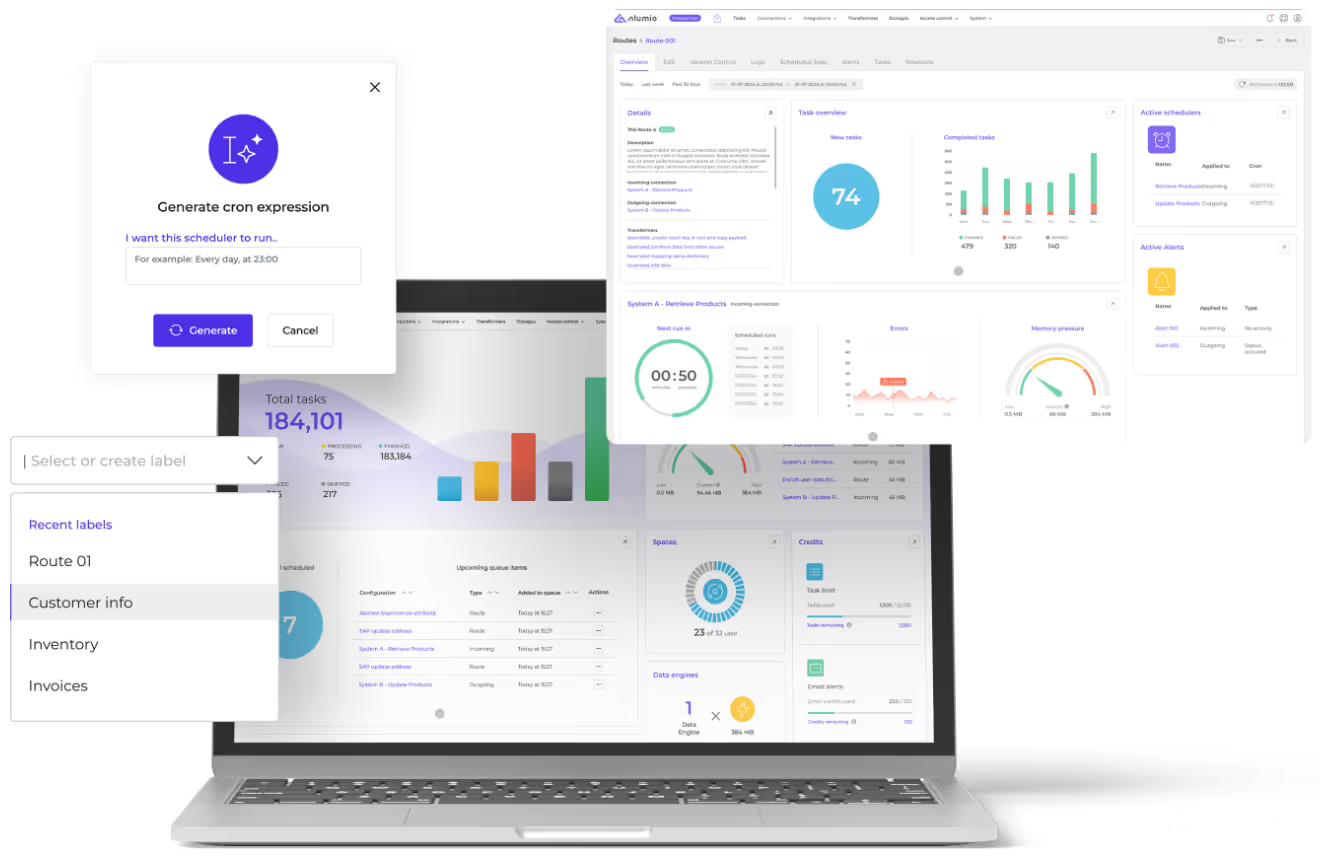
The Alumio iPaaS supports this progression by design. Early integrations get built on the same Routes, Transformers, and Mappers that backbone integrations use. As the business grows, the integration layer scales without architectural rework. Reusable connector libraries, consolidated authentication, centralized observability, and audit trails are available from the first integration, even when the business isn't using them yet. By the time the business needs governance, the platform already has it.
Many Alumio deployments happen through certified system integrators and digital agencies, who bring the architectural experience to design the foundation right at the lite stage so the core and backbone stages don't require redesign.







.svg)
.svg)
.svg)
.svg)
.svg)
.svg)
