From basic decoupling to composable architecture
The first phase of headless commerce was structural. Retailers separated their CMS from their e-commerce platform, allowing marketing teams to update the front end independently while the commerce engine handled transactions in the background. It was a meaningful step, but it still left businesses dependent on a single monolithic back-end to handle inventory, search, pricing, and customer accounts.
The next phase introduces composable commerce. Rather than relying on one platform to manage every back-end function, businesses adopt specialized, best-of-breed services for each capability: a dedicated search tool, a separate PIM for product data, an independent OMS for order management, a specialized loyalty platform, and so on.
This gives businesses more control over each individual function and more flexibility to swap components as better options emerge. But it also introduces a new challenge. The question is no longer how to display data beautifully on a storefront. It is how to ensure that dozens of independent systems communicate accurately and reliably, at scale, in real time.
Scalability that works at a component level
Monolithic e-commerce platforms force businesses to scale the entire system when any part of it comes under load. A traffic spike during a promotional event requires additional resources to be allocated across the whole application, even if the increased demand only affects the search function. That creates unnecessary overhead.
Headless architectures with independent microservices allow scaling to happen at the component level. If the product configurator experiences high demand during a campaign, resources can be directed to that specific service without touching the rest of the stack. Other functions continue running at their usual capacity.
The same principle applies to geographic expansion. Entering a new market does not require replicating the entire commerce platform. A localized front-end can connect to existing global back-end services, with only the region-specific components, such as local payment gateways or tax calculation services, added on top. That makes new market deployments significantly more manageable than a full platform rollout.
A unified data foundation across every channel
Modern consumers move between channels in ways that make channel-specific data silos an immediate problem. A customer might browse on mobile, compare on desktop, and complete a purchase in-store. If each of those touchpoints reads from a different data source, the experience becomes inconsistent.
Composable headless architectures address this by creating a shared data foundation. Every touchpoint, whether a mobile app, desktop browser, in-store kiosk, or voice interface, accesses the same back-end services via APIs. When a customer adds an item to their cart on mobile, that state is immediately available on desktop or in-store point-of-sale. Inventory levels, pricing, and promotions stay consistent across all channels because they all draw from the same source.
This consistency matters both operationally and commercially. It reduces the kind of friction that causes customers to abandon a purchase when what they see online does not match what’s in-store.
Why the integration layer is what makes this work
Adopting twenty specialized microservices creates a highly capable architecture on paper. In practice, each additional service is another system that needs to exchange data reliably with everything around it. Attempting to manage those connections through custom point-to-point code creates a fragile infrastructure. When a vendor updates their API, a hardcoded connection breaks. Fixing it requires developer time that could be spent elsewhere, and the failure often surfaces as a broken checkout or inconsistent inventory before anyone catches it internally.
An integration platform-as-a-service (iPaaS) provides a more stable alternative. Rather than connecting services directly to each other, each system connects to a central integration layer that manages data routing, format translation, and API traffic. It acts as the orchestration layer between the commerce platform, ERP, PIM, OMS, and the wider application landscape, keeping data flowing consistently across the full stack and giving teams real-time visibility into data flows and errors.
When a customer runs a search, the integration layer routes the request to the search microservice, retrieves the result, enriches it with pricing data from the ERP, and returns it to the front-end. All of that happens within a single governed environment with centralized monitoring and error logging.
How to move toward an orchestrated headless architecture
Transitioning from a monolithic setup to a composable, orchestrated architecture requires a structured approach rather than a complete overnight replacement.
- Audit the existing stack: Identify which functions are currently handled by monolithic systems and which would benefit most from being replaced by a specialized service. Search, product content, and order management are common starting points because they are frequently the areas where businesses feel the most constraint.
- Adopt an API-first approach to procurement: Every new service added to the stack needs to expose well-documented APIs. The reliability of the whole architecture depends on how well individual components can exchange data programmatically. Evaluating API quality and documentation should be part of any procurement decision.
- Establish the integration layer before expanding the stack: Before adding more microservices, connect existing systems through a central integration layer. This creates a governed foundation for data flows and makes it significantly easier to add new components later without rebuilding connections from scratch each time.
- Define clear data ownership across systems: PIM, ERP, and CRM should each serve as the authoritative source for their respective data categories. Ambiguity about which system holds the master record for a given data type tends to create inconsistencies that compound across channels over time.
- Build in monitoring from the start: As data flows continuously between more systems, visibility into API performance, error rates, and failed transfers becomes essential. Centralized monitoring across the integration layer makes it possible to identify and address issues before they affect the customer experience.
Future headless commerce: composable commerce integrations
Headless commerce is no longer just a front-end development approach. It has become the underlying architectural strategy for how businesses operate, scale, and adapt their digital commerce operations. The shift toward composable, microservice-driven ecosystems gives organizations more flexibility and more specialized capability at each layer of the stack.
But that flexibility only delivers its full value when the integration architecture behind it is solid. Disconnected microservices create data silos and inconsistent experiences just as readily as a poorly configured monolith. The orchestration layer is what turns a collection of best-of-breed tools into a coherent, functioning system.
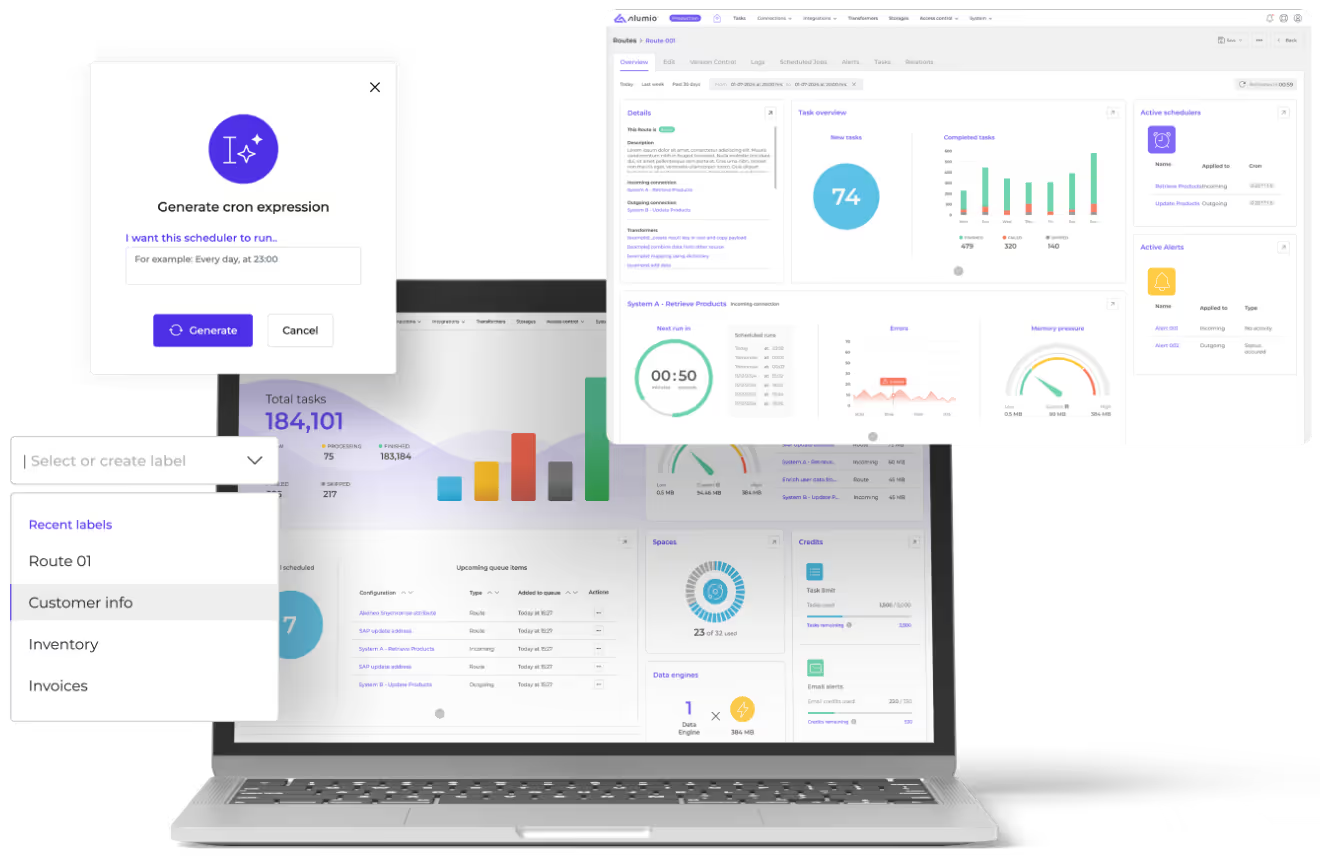
For businesses building toward that architecture, Alumio provides the integration infrastructure to connect commerce platforms, ERP, PIM, OMS, and other services through a central layer that keeps data synchronized, flows monitored, and the ecosystem manageable as it grows.





.svg)








.svg)
.svg)
.svg)
.svg)
.svg)
.svg)
