The real technical challenge in Shopware to Shopify migration
Shopware and Shopify structure data differently. Product variants, attributes, tax rules, and customer segmentation logic do not map one-to-one. What appears as a simple catalog transfer often reveals deeper structural differences once migration begins.
For example, variant handling in Shopware may rely on attribute combinations that exceed Shopify’s default limits. Custom pricing logic tied to customer groups may require transformation into Shopify metafields or separate pricing structures. Category hierarchies in Shopware translate into Shopify collections with different behavioral logic. These differences require deliberate transformation, not direct copying.
When migration is treated as a database export followed by bulk import, errors surface late in the process. Products may appear correctly but contain broken relationships. Customer records may migrate without segmentation metadata. Operational inconsistencies often become visible only after launch.
Preserving SEO value during platform migration
One of the most immediate commercial risks in a Shopware to Shopify migration is SEO disruption. Shopware URL structures differ from Shopify’s standardized format. If legacy URLs are not mapped carefully to new equivalents, search engines encounter broken links and ranking signals are lost.
A structured migration must therefore include complete URL mapping, implementation of permanent 301 redirects, and validation of meta titles, descriptions, and structured data. SEO preservation is not automatic. It requires controlled planning and technical execution before go-live. When handled correctly, organic visibility can be maintained. When rushed, traffic and revenue can decline quickly.
Why migration is fundamentally an integration problem
During migration, the business does not pause. Orders continue processing. Inventory levels fluctuate. ERP systems generate invoices. Customers create accounts and submit support requests. A static data export cannot account for these live updates.
This is where many migrations fail. A compressed “big bang” cutover concentrates risk into a single launch window. Testing is rushed. Delta updates are missed. Manual corrections follow.
The more reliable approach treats migration as a live synchronization challenge. The Alumio integration platform enables this by acting as a middleware layer between Shopware and Shopify, connecting both platforms via their APIs rather than through flat file transfers.
Bridging Shopware to Shopify migration with the Alumio iPaaS
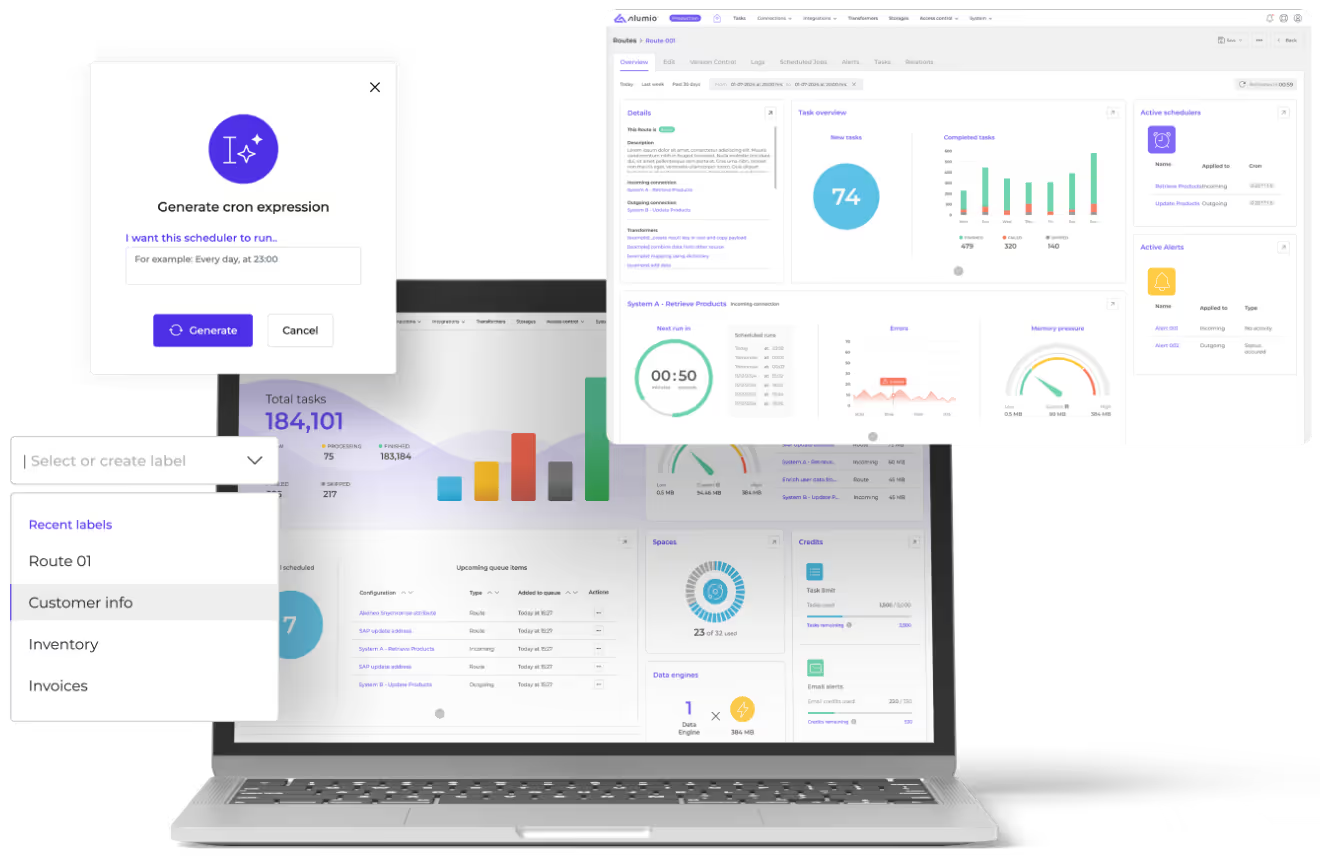
Using the Alumio integration platform-as-a-service (iPaaS), migration becomes a governed process rather than a manual transfer. Instead of manual exports and imports, Alumio connects to both Shopware and Shopify APIs, allowing structured data flows to move through a centralized integration layer.
- Automated data transfer: Historical such as products, customers, and order history can be transferred through API-based synchronization. Because data flows are logged and monitored, inconsistencies can be detected early rather than after launch.
- Data transformation: Alumio enables data transformation in transit. Shopware attributes can be reshaped to fit Shopify’s product model. Custom fields can be mapped into metafields. Pricing logic can be adjusted centrally. Instead of modifying data manually, transformation rules are defined once and applied consistently.
- Phased migration: You can run both systems in parallel, syncing data continuously until you are ready to switch. Historical data is migrated first. Delta updates are synchronized continuously while both platforms operate in parallel. When the final cutover occurs, the new Shopify environment is already current. The migration window becomes a controlled transition rather than a high-risk event.
Rebuild system integrations post migration without development cost
One of the most overlooked costs in a Shopware to Shopify migration is integration redevelopment. ERP, PIM, CRM, WMS, and marketing systems connected to Shopware must be redirected to Shopify. Without a centralized integration layer, each connection is rebuilt independently, increasing complexity and long-term maintenance effort.
With the Alumio integration platform in place, integrations are abstracted at the middleware level. Endpoint logic is managed centrally. When Shopify replaces Shopware, transformation and orchestration rules remain within the integration platform. This significantly reduces redevelopment effort and helps prevent the accumulation of new point-to-point dependencies.
From a total cost of ownership perspective, this architectural decision often has more impact than subscription pricing differences between platforms. Reducing integration rework lowers long-term maintenance overhead and improves system observability.
Lowering downtime risk of system migration with an iPaaS
Migration risk is ultimately commercial risk. Extended downtime or data inconsistencies directly affect conversion rates, order fulfillment, and customer trust.
By enabling phased synchronization, centralized monitoring, and rollback readiness, the Alumio iPaaS reduces exposure during transition. Data flows are traceable. Errors can be isolated and retried. Systems can operate in parallel until validation is complete.
This controlled approach reduces the likelihood of emergency fixes after launch and protects revenue during the transition period.
Turning migration into an architectural upgrade with Alumio
A Shopware to Shopify migration should not recreate fragile integrations in a new environment. It should standardize how systems connect. By introducing the Alumio integration platform as the orchestration layer during migration, organizations gain more than a new storefront. They gain centralized visibility, reusable transformation logic, and a scalable integration backbone that connects Shopify to ERP, PIM, CRM, marketplaces, and logistics providers. Migration then becomes an opportunity to reduce integration complexity, protect SEO equity, and lower long-term operational risk. The strategic advantage lies not in the platform switch itself, but in establishing a governed integration architecture that makes future changes predictable rather than disruptive.





.svg)









.svg)
.svg)
.svg)
.svg)
.svg)
.svg)
