Understanding the integration approaches
When connecting marketplaces to core systems like ERP and PIM, there are three primary methods for connecting your back-office systems to online marketplaces:
- Direct API integrations: This involves writing custom code to connect your systems directly to each marketplace's API. A developer on your team builds a specific connection for syncing products to Amazon, another for eBay, and so on.
- Marketplace integrator platforms: These are specialized SaaS solutions designed exclusively for marketplace management. They offer pre-built connectors for major marketplaces and provide a user interface to manage product listings, orders, and inventory.
- Middleware (iPaaS): An Integration Platform as a Service (iPaaS) is a centralized platform for building and managing all enterprise integrations, not just marketplaces. It connects your ERP, PIM, and other systems to marketplaces, but also to your webstore, CRM, and logistics providers.
The illusion of cost savings with direct API integrations
Building direct, custom integrations is often perceived as the most cost-effective solution because it avoids recurring software licensing fees. However, this view overlooks the full scope of TCO.
Pros of direct API integrations:
- No initial licensing cost: You are only paying for internal developer time or a one-off freelance project.
- Complete control: You have granular control over every line of code and can build highly specific logic.
Cons of direct API integrations:
- High development cost: Each marketplace API is a complex project. Your team must learn its authentication methods, data models, and error codes. Building a robust connection for a single marketplace can take hundreds of development hours.
- Exponentially increasing complexity: Each new marketplace adds another point-to-point connection, creating a fragile "spaghetti architecture." Managing ten direct integrations is exponentially more complex than managing one.
- Extensive maintenance burden: Marketplace APIs are not static. They change frequently. When Amazon updates its API, your development team must stop other work to patch the integration. This reactive maintenance consumes significant resources.
- Lack of scalability: This model does not scale efficiently. The time and cost to add your tenth marketplace will be just as high as the first, if not higher, due to increasing complexity.
The TCO of a direct integration includes not only the initial build but also the ongoing developer salaries dedicated to maintenance, debugging, and patching. This often far exceeds the licensing cost of a middleware solution.
The specialized efficiency of marketplace integrators
Marketplace integrator platforms like ChannelEngine offer a streamlined, focused solution for businesses whose primary need is marketplace connectivity.
Pros of marketplace integrators:
- Fast time-to-market: These platforms feature pre-built connectors, allowing you to get listed on a new marketplace in days, not months.
- Simplified management: They provide a user-friendly interface for managing listings, pricing, and orders across multiple channels from one place.
- Maintenance is included: The platform provider is responsible for keeping the connectors up-to-date with the latest API changes from each marketplace.
Cons of marketplace integrators:
- Limited scope: These tools are excellent for marketplace integration but do not solve other integration needs. You will still need separate solutions to connect your ERP to your CRM or your WMS to your shipping provider.
- Potential for data silos: The integrator becomes another "island" of data. Getting data from the integrator into your central ERP or BI tool can still be a challenge if the platform has limited outbound API capabilities.
- Less flexibility: You are dependent on the platform's features and data mapping capabilities. If you have a highly custom business process, the platform may not be able to support it.
Marketplace integrators are an excellent choice for businesses that want a fast and efficient way to manage marketplace channels without extensive custom development.
The iPaaS integration route: ERP + Alumio + marketplace connector + marketplaces
A modern approach to marketplace integration leverages a structured route to maximize flexibility and control over data flows. The preferred architecture for scalable, maintainable integrations is:
ERP → Alumio → Marketplace Connector (e.g., ChannelEngine, Mirakl) → Marketplaces (Zalando, About You, Amazon, Bol, etc.)
In this model, Alumio acts as a robust middleware layer between your ERP and the marketplace connector platform. Alumio ensures seamless data exchange for products, pricing, inventory, and orders, transforming and mapping information according to the needs of each connected party. The marketplace connector (such as ChannelEngine or Mirakl) then manages interactions with a wide range of online marketplaces, abstracting the complexities of differing APIs.
Key advantages of this integration route:
- Centralizes data orchestration and transformation in Alumio, ensuring your ERP remains the source of truth.
- Reduces integration workload when scaling to new marketplaces, since each new channel is managed via the marketplace platform connector.
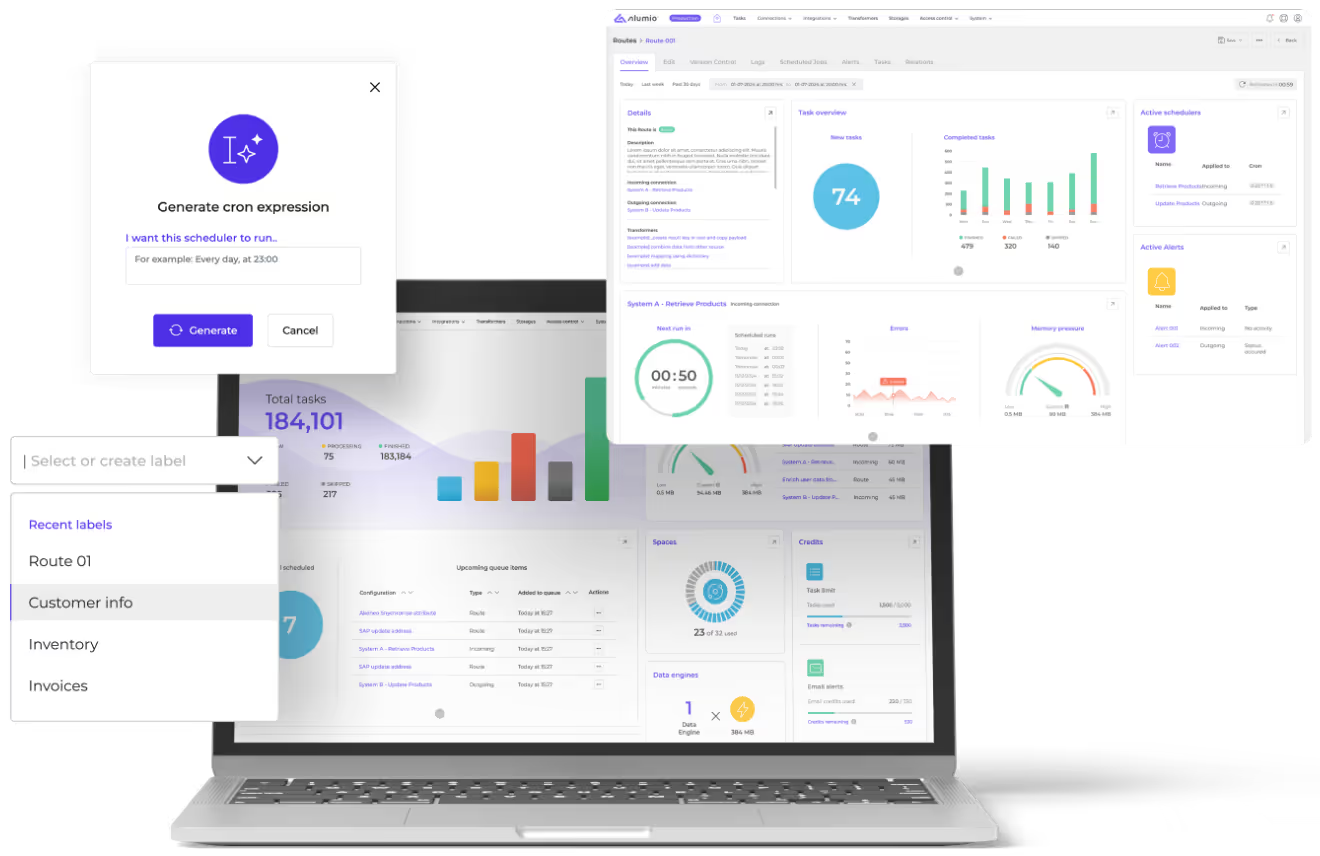
- Simplifies ongoing compliance and error handling through Alumio’s monitoring and logging capabilities.
- Facilitates rapid response to changes in marketplace API specifications, as updates can be handled centrally.
Alumio supports and accelerates ERP-to-marketplace connector integrations with pre-built connectors and expert guidance. Whether you're connecting SAP, Microsoft Dynamics, or another ERP to ChannelEngine, Alumio’s solution maximizes reusability and scalability.
Read more about how the ChannelEngine Connector that the Alumio integration platform simplifies marketplace integration →
Reducing TCO through architectural separation
Reducing TCO in marketplace integrations is not about minimizing subscription fees. It is about minimizing lifecycle complexity.
Direct integrations may appear economical initially, but maintenance overhead, API volatility, and scaling friction often erode those savings. Marketplace connectors streamline channel expansion but still require structured orchestration to prevent silos.
A layered architecture—where marketplace connectors handle channel-specific complexity and an integration platform manages orchestration and governance—provides the most predictable long-term model. It protects ERP stability, centralizes transformation logic, and absorbs change without structural rework.
Marketplace expansion is continuous, not project-based. The integration architecture you establish today determines whether growth compounds revenue—or compounds technical debt.
Why middleware is the foundation for future-proof marketplace integrations
Leveraging middleware like Alumio for marketplace connections delivers lasting value: accelerated rollout to new channels, reduced total cost of ownership, simplified compliance, and unmatched operational resilience. For businesses seeking sustainable, unified omnichannel growth, a centralized integration layer is the strategic anchor that enables scalability, adaptability, and success in a rapidly evolving digital marketplace environment.
The decision between building direct integrations and using a platform comes down to your strategic vision.
- Direct API integrations are a short-term solution that creates long-term technical debt. The TCO is high due to ongoing maintenance and the lack of scalability.
- Marketplace integrators are an efficient, tactical choice for businesses focused solely on marketplace management. They offer a fast time-to-market at a predictable cost.
- Middleware (iPaaS) is a strategic investment in a scalable, future-proof architecture. By centralizing all integrations, it lowers the TCO across the entire enterprise, enhances data governance, and provides the agility needed to compete in a rapidly changing digital landscape.
For most growing e-commerce businesses, the initial cost of building a direct integration is a false economy. A platform-based approach, whether a specialized integrator or a comprehensive iPaaS, provides a more predictable and lower Total Cost of Ownership when factoring in the full lifecycle of development, maintenance, and scalability.





.svg)









.svg)
.svg)
.svg)
.svg)
.svg)
.svg)
