





.svg)



Why predictive maintenance is a data integration problem
Most conversations about predictive maintenance focus on the algorithms: which model best predicts bearing failure, which vendor offers the most accurate vibration analysis, which platform integrates AI with sensor streams. Those choices matter, but they sit on top of a deeper question that most predictive maintenance projects underestimate at the start. The model is only as good as the data feeding it, and in most manufacturing environments, the data feeding it is fragmented across systems that were never designed to share information continuously.
That structural gap is what makes predictive maintenance harder than it looks on a slide. A vibration sensor on a motor produces clean signals, but those signals only mean something when paired with machine load, ambient temperature, maintenance history, and operating context from the ERP. Stitching those together at the speed predictive models need is the actual engineering challenge. Manufacturers that solve the data integration layer before scaling predictive maintenance see real returns, while those that skip it tend to discover the gap mid-deployment, when the model is in place but the data feeding it isn't ready.
What data does predictive maintenance actually need?
Predictive maintenance needs three categories of data, drawn from different layers of the manufacturing stack: real-time machine telemetry from the OT layer, historical operating context from production systems, and maintenance event records from CMMS or asset management systems. The predictive value emerges from combining all three.
Real-time machine telemetry is the visible part. Vibration sensors, temperature probes, oil quality monitors, pressure gauges, and power meters generate continuous streams of operational data, either natively from modern equipment or through retrofit IoT devices on older assets. The telemetry tells the model what the asset is doing right now.
Historical operating context provides the baseline. Production volumes, shift patterns, load profiles, ambient conditions, and changes to operating parameters all influence how an asset wears. Without this context, the model treats every vibration anomaly the same, even though a vibration spike under peak production load means something different from the same spike during a maintenance run.
Maintenance event records close the loop. Past failures, recent repairs, parts replacements, and inspection results train the model on what normal versus pre-failure conditions look like for each specific asset. That history is what lets the model leverage years of accumulated operating knowledge instead of learning from scratch on every deployment.
Why is fragmented data the real bottleneck in predictive maintenance?
The bottleneck is fragmentation because predictive maintenance needs data from systems that operate in fundamentally different worlds. Sensor data lives in OT systems. Operating context lives in MES and ERP. Maintenance records live in CMMS or asset management systems. Production schedules live in planning systems. Each typically sits in a different IT environment, owned by a different team, accessed through different interfaces, and updated on different cycles.
The result is a familiar pattern in predictive maintenance deployments. The model gets deployed, runs successfully on data from one or two sources, and produces useful predictions for a narrow use case. Then scaling the deployment exposes the fragmentation. Adding more assets means connecting to more sensors, adding more failure modes means pulling more context from more systems, and adding more accuracy means combining sources that were never designed to be combined. The model's intellectual capacity hits a ceiling that the data architecture imposes on it.
This is why predictive maintenance projects that look successful at the pilot stage often stall at scale. The pilot was running on a curated data set, while the production deployment runs on the actual data architecture, which usually isn't ready for it.
How an integration platform feeds the algorithm with reliable signals
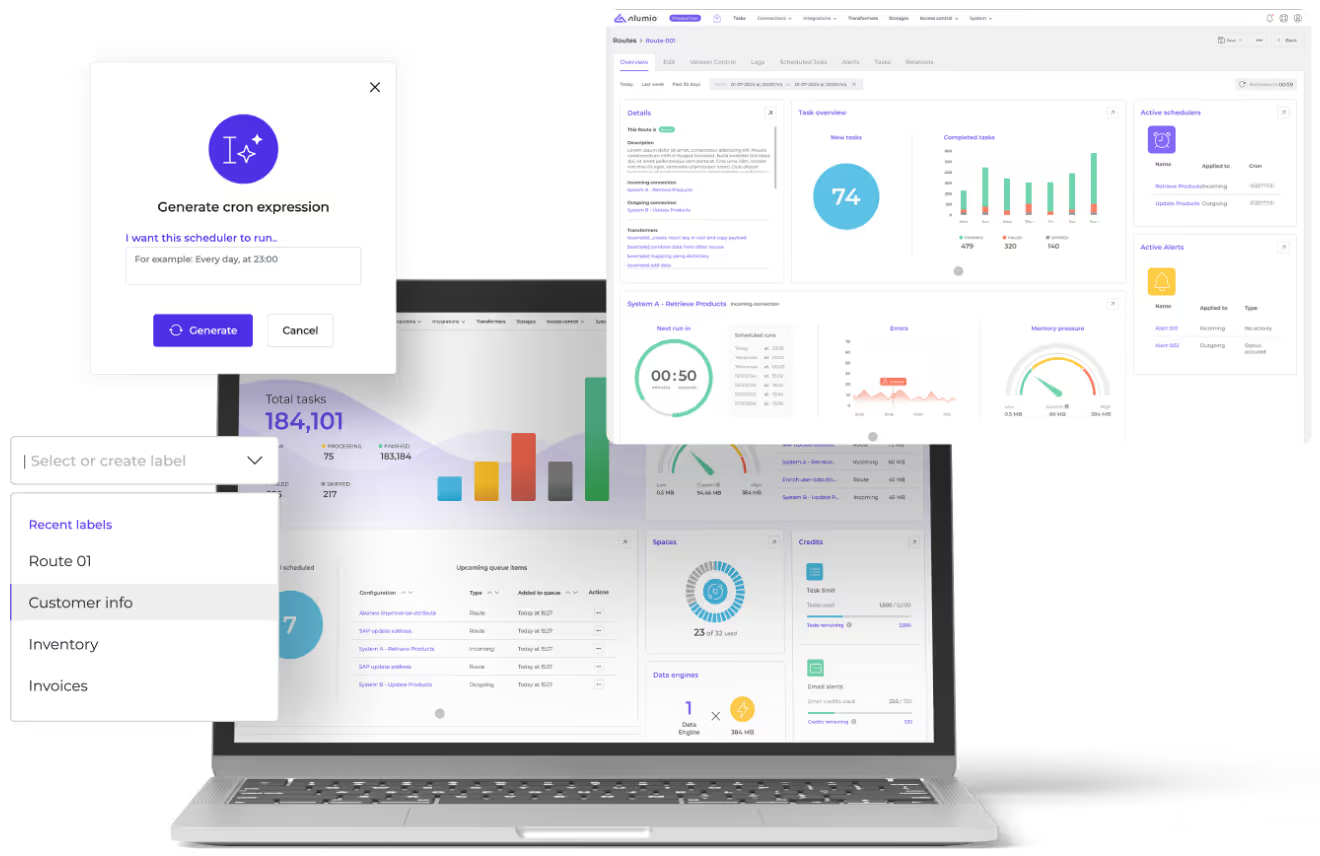
An integration platform-as-a-service (iPaaS) handles the connectivity, transformation, and orchestration that data integration for predictive maintenance requires. Rather than building one-off connections between each data source and each predictive model, an iPaaS centralizes the integration logic, normalizes data into structures models can consume, and routes the flows across the stack.
The Alumio iPaaS supports predictive maintenance workflows by bridging the OT and IT layers that hold the data PdM needs. On the OT side, it connects to sensor brokers, industrial gateways, and unified namespace layers. On the IT side, it connects to ERP, MES, CMMS, and analytics platforms. It transforms and contextualizes data flowing between them, handling the schema differences, frequency conversions, and validation that turn raw telemetry into model-ready input.
The integration layer also provides the observability that production predictive maintenance deployments need. When a model starts producing low-quality predictions, the integration layer makes it possible to trace back which data source changed, which transformation broke, or which downstream system fell behind. Without that observability, model drift gets diagnosed slowly and fixed reactively.
Most Alumio deployments happen through certified system integrators and specialist industrial consultants. That partner-led model matters in predictive maintenance because the integration design has to reflect the specific sensor stack, machine vintage, and maintenance practices each plant runs.




.svg)
.svg)
.svg)
.svg)
.svg)
.svg)
