Why native HubSpot integrations often fall short
Most organizations begin with native apps or lightweight connectors from the HubSpot marketplace. These integrations are useful for simple use cases, but limitations appear quickly as business complexity grows.
Common challenges include:
- Limited support for custom objects and fields
- Inflexible field mappings
- No advanced transformation logic
- Minimal visibility into failures
- Tight coupling between systems
When integrations are built directly between HubSpot and other applications, every system change introduces risk. Replacing an ERP or modifying pricing logic can require reworking multiple integrations. Over time, this creates technical debt and operational fragility.
To use HubSpot as a strategic system rather than a marketing tool, connectivity must be standardized and governed. This is where the Alumio integration platform works as the ideal solution.
Why HubSpot needs an integration layer to scale
HubSpot’s CRM is built around core objects like contacts, companies, deals, and other CRM records, which can also be extended with custom properties and custom objects. In practice, that flexibility creates an integration challenge: the more your CRM reflects real business processes, the more it must stay in sync with systems that run those processes.
The Alumio integration platform-as-a-service (iPaaS) acts as a middleware layer between HubSpot and the rest of your IT landscape. Instead of connecting systems directly, each application connects to the integration platform that works as a central orchestration layer. Sitting between HubSpot and your other applications, the Alumio integration platform manages all data movement between them and keeps it consistent. In other words, instead of HubSpot needing to understand the data structure, API behavior, and edge cases of every other system, the integration layer manages translation, routing, transformation, and operational controls in one place.
This architectural separation reduces dependency between systems. If you replace your ERP or introduce a new commerce platform, your HubSpot CRM integration does not need to be rebuilt from scratch. You adjust the connector within the integration platform, preserving business continuity.
For technical leaders, this reduces integration rework, lowers long-term maintenance costs, and improves change management.
Unifying customer, order, and financial data in HubSpot
A CRM is only as valuable as the data it aggregates. When HubSpot is disconnected from operational systems, sales and marketing teams work with incomplete context. Integrating HubSpot via Alumio enables synchronization of critical business entities across systems.
Synchronizing core data objects
Examples of structured data flows include:
- Contacts and companies: Convert qualified leads in HubSpot into customer records in the ERP once deals are closed.
- Products and pricing: Pull real-time inventory and pricing from ERP or WMS into HubSpot to support accurate quoting.
- Orders and invoices: Push closed deals into finance systems for invoicing and sync payment status back into HubSpot.
This eliminates manual duplication and reduces the risk of inconsistent records across platforms.
For revenue teams, this improves forecasting accuracy. For finance teams, it shortens billing cycles. For IT, it centralizes integration governance.
Automating workflows across sales, marketing, and operations
Manual data entry remains one of the largest hidden costs in CRM operations. Each manual transfer introduces delay and error risk.
An integration platform enables event-driven automation between systems.
For example:
- A demo request submitted on a website triggers automatic deal creation in HubSpot.
- Regional routing logic assigns the opportunity to the correct account executive.
- Slack or Teams notifications alert the relevant team.
- ERP validation checks confirm VAT numbers before customer creation.
These workflows reduce administrative overhead and ensure consistent process execution.
Automation improves response times, reduces human error, and allows teams to focus on revenue-generating activities rather than data management.
Supporting complex HubSpot data mapping and transformation
Many organizations operate with custom objects, regional pricing structures, subscription models, or legacy databases. Native connectors rarely support these scenarios.
The Alumio integration platform provides structured mapping and transformation capabilities that support more advanced integration logic. You can configure Alumio to handle intricate mapping requirements with HubSpot such as:
- Data formatting: Convert date formats (e.g., DD/MM/YYYY to MM-DD-YYYY) to ensure systems understand each other.
- Conditional logic: Only sync contacts to the ERP if they have a valid VAT number and are marked as "Qualified" in HubSpot.
- Field mapping: Map custom fields in HubSpot to corresponding custom tables in legacy databases without writing a single line of code.
This flexibility ensures that your integration adapts to your business processes, rather than forcing your business to adapt to the limitations of a plugin or connector.
For integration architects, this means fewer workarounds and more maintainable integration logic.
Centralized monitoring and logging of HubSpot integrations
One of the most overlooked benefits of an integration platform is operational visibility.
As your organization grows, maintaining data quality becomes increasingly difficult. Without a central governance layer, bad data spreads quickly. A duplicate contact created in one system replicates across all others, corrupting your reporting.
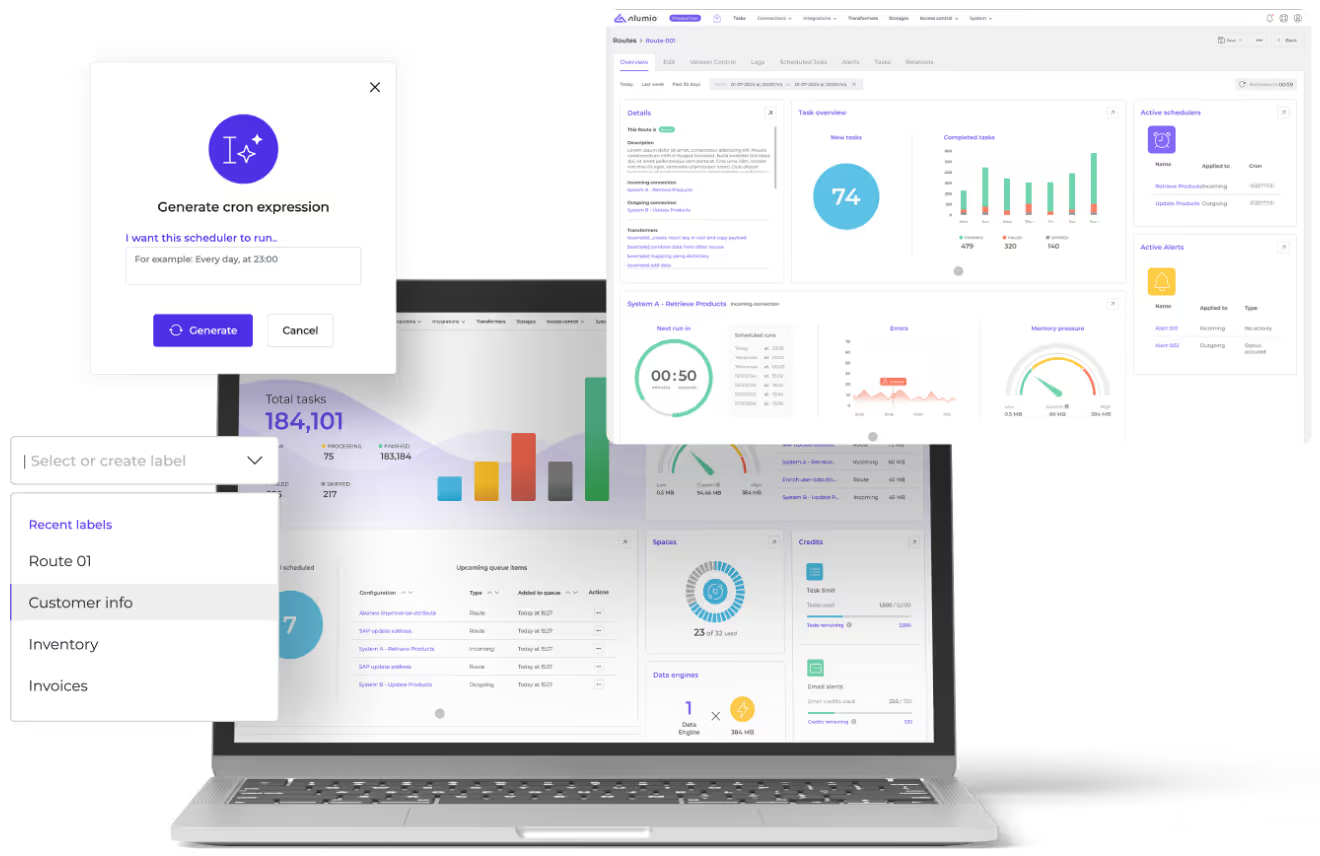
Alumio provides the governance tools necessary to maintain a clean database. The platform offers complete visibility into your integration flows.
- Monitoring and logging: You can track every data transfer in real-time. If a sync fails—perhaps because an email address was invalid—Alumio logs the error and alerts your IT team.
- Automatic retries: The system can automatically retry failed tasks, preventing temporary network glitches from causing permanent data gaps.
- Audit trails: For regulated industries, having a complete history of how data moved and changed is essential for compliance.
For organizations operating in regulated industries, having traceability of data movement is essential. For growth-stage companies, centralized monitoring improves operational control as system complexity increases. As such, wthe centralized governance model that the Alumio integration platform provides reduces risk and increases trust in CRM reporting.
Scaling HubSpot integrations as your stack evolves
Technology stacks change. Organizations adopt new marketing tools, replace ERP systems, expand into new e-commerce channels, or acquire subsidiaries.
In point-to-point architectures, each new system multiplies integration complexity. Changes require code rewrites and regression testing across multiple connections.
With the Alumio integration platform acting as a central hub:
- New systems connect once to the platform
- HubSpot integration logic remains intact
- Endpoint replacements require configuration, not redevelopment
This reduces reimplementation effort and accelerates expansion into new channels or markets. Scalability becomes predictable rather than disruptive.
Turning HubSpot into an operational growth engine
HubSpot CRM is often positioned as a marketing and sales platform. Its real value emerges when it becomes tightly connected to operational systems.
Integrating HubSpot through an integration platform such as Alumio enables:
- Unified customer visibility
- Automated cross-system workflows
- Controlled data governance
- Reduced integration maintenance
- Scalable architecture
Rather than managing isolated connectors, organizations establish a standardized integration framework that supports both current operations and future change.
For CTOs and IT leaders, the strategic objective is not simply connecting HubSpot. It is ensuring that CRM data flows reliably across ERP, commerce, finance, and support systems without creating technical debt. The Alumio integration platform provides the architectural control to achieve that objective.





.svg)









.svg)
.svg)
.svg)
.svg)
.svg)
.svg)
