

A Alumio vivid purple arrow pointing to the right, a visual representation of how to access more page material when clicking on it.
Go back

What is a message queuing service?

By
Carla Hetherington
Published on
June 17, 2024
Updated on
June 24, 2026
IN CONVERSATION WITH
Email icon
Email icon

When it comes to the optimal functioning of one or more technology services, the seamless exchange of information is crucial. Whether it's an e-commerce website processing thousands of transactions per second or a social media platform handling millions of messages, efficient data communication is key. Enter messaging queuing services – the unsung heroes that ensure data flows smoothly and reliably. But what exactly are they, and why are they so essential? Let's delve into message queues and messaging queuing services to understand their significance in modern technology.

What is a message queue?

A message queue is a form of asynchronous service-to-service communication used in serverless and microservices architectures. It acts as an intermediary that stores and forwards messages between various system components. Imagine it as a line in a bank where each message (task) waits its turn to be processed by a service (teller). This setup ensures no message is lost and services can operate independently, improving system reliability and efficiency.

What is a messaging queuing service?

A messaging queuing service is a cloud-based or on-premises solution that manages message queues. These services provide the infrastructure needed to create, maintain, and scale message queues without requiring significant development effort from the user. Popular examples include Amazon Simple Queue Service (SQS), Apache Kafka, and RabbitMQ. They handle the complexities of message distribution, scaling, and fault tolerance, allowing developers to focus on building core features of their applications.

How does a messaging queuing service work, and what tasks does it perform?

Messaging queuing services work by receiving messages from producers (applications or services) and storing these messages in a queue until they are retrieved by consumers (other applications or services). Consumers then fetch messages from the queue, process them, and potentially send back a response. The service ensures reliability by guaranteeing messages are delivered at least once and handling retries in case of failure, thereby maintaining message integrity. Additionally, it automatically scales to handle varying loads, ensuring consistent performance. These tasks allow systems to decouple and operate independently, leading to more resilient and maintainable architectures.

Use case of a messaging queuing service

Consider an e-commerce platform during a holiday sale. With thousands of orders pouring in per second, directly processing each order in real-time could overwhelm the system, leading to slowdowns or crashes. By implementing a messaging queuing service, the platform can send order details to a message queue when a customer places an order. Backend services pull orders from the queue and process them at a manageable rate, ensuring each order is handled correctly without overloading the system. Once processed, a message can be sent to another queue to notify the customer or update inventory systems. This decoupled approach ensures smooth operation even under heavy load, enhancing user experience and system reliability.

The importance of messaging queuing services in modern technology

Messaging queuing services are pivotal in modern technology for several reasons. By decoupling producers and consumers, these services allow each component to operate independently, enhancing modularity and maintainability. They provide the ability to handle varying loads gracefully, ensuring systems can scale as needed without manual intervention. Additionally, they ensure messages are delivered reliably, even in case of service failures, enhancing overall system robustness. By smoothing out peaks and troughs in demand, they optimize resource usage and prevent over-provisioning.

In a nutshell, messaging queuing services are a cornerstone of modern distributed systems. They enable robust, scalable, and efficient communication between different parts of an application, ensuring smooth operation even under unpredictable loads. As technology continues to evolve, the role of these services will only grow, making them an indispensable tool in the arsenal of any modern developer or enterprise.


Turn AI ambition into action

Portrait of Leonie Becher Merli, Business Development Manager at Alumio

Get a free assessment of your integration needs and next steps

Portrait of Leonie Becher Merli, Business Development Manager at Alumio

No items found.
Topics in this blog:

FAQ

Integration Platform-ipaas-slider-right
What is a message queue and how does it work?

A message queue is an asynchronous communication mechanism where a producer sends a message to a queue and a consumer reads and processes it independently, without requiring both to be active at the same time. Messages persist in the queue until the consumer retrieves and acknowledges them. This decoupling allows systems to communicate reliably even when one side is temporarily unavailable, handling spikes in message volume by buffering rather than dropping messages.

Integration Platform-ipaas-slider-right
What is a message queuing service and what are some examples?

A message queuing service is a managed platform providing message queue infrastructure without requiring organizations to build and operate their own. Examples include Amazon SQS, Google Cloud Pub/Sub, Azure Service Bus, RabbitMQ (open-source, self-hosted or managed), and Apache Kafka (for high-throughput event streaming). Each has different characteristics around ordering guarantees, message retention, throughput capacity, and delivery semantics that make them better suited to different use cases.

Integration Platform-ipaas-slider-right
What are the main use cases for message queuing in e-commerce and enterprise systems?

Common use cases are: decoupling order placement from order processing (an order is placed in the queue and processed when ready, smoothing traffic spikes), distributing work across multiple consumers for parallel processing, ensuring reliable event delivery between microservices, and buffering high-volume data flows like inventory updates or product feed changes. Message queues are particularly valuable wherever a producer generates messages faster than a consumer can process them.

Integration Platform-ipaas-slider-right
What is the difference between a message queue and an event stream?

A message queue is designed for point-to-point or task-queue patterns: each message is typically consumed once by one consumer, then removed from the queue. An event stream (as provided by Kafka or Kinesis) stores an ordered log of events that can be replayed and consumed by multiple independent consumers, each at their own position in the stream. Message queues suit task distribution and reliable delivery; event streams suit real-time analytics, audit logs, and scenarios where multiple systems need to consume the same event independently.

Integration Platform-ipaas-slider-right
How does message queuing relate to integration platforms?

Message queuing and integration platforms are complementary: message queues handle the reliable, asynchronous delivery of messages between systems, while an integration platform handles the routing, transformation, monitoring, and governance of data flows. Some integration platforms, including Alumio, incorporate queue-based storage to buffer data between connected systems, ensuring that temporary unavailability of one system does not cause data loss while maintaining full audit logging of every data exchange.

Integration Platform-ipaas-slider-right
What are the key factors to consider when choosing a message queuing service?

The key factors are: ordering guarantees (does the application require strictly ordered message delivery), message retention period (how long should messages be stored if not consumed), throughput requirements, at-least-once versus exactly-once delivery semantics, and operational overhead (managed cloud services require less operational management than self-hosted infrastructure). For most enterprise integration use cases, a managed cloud queuing service with at-least-once delivery and idempotent consumer design covers the requirements without the overhead of running self-hosted infrastructure.

Get a free assessment of your integration needs

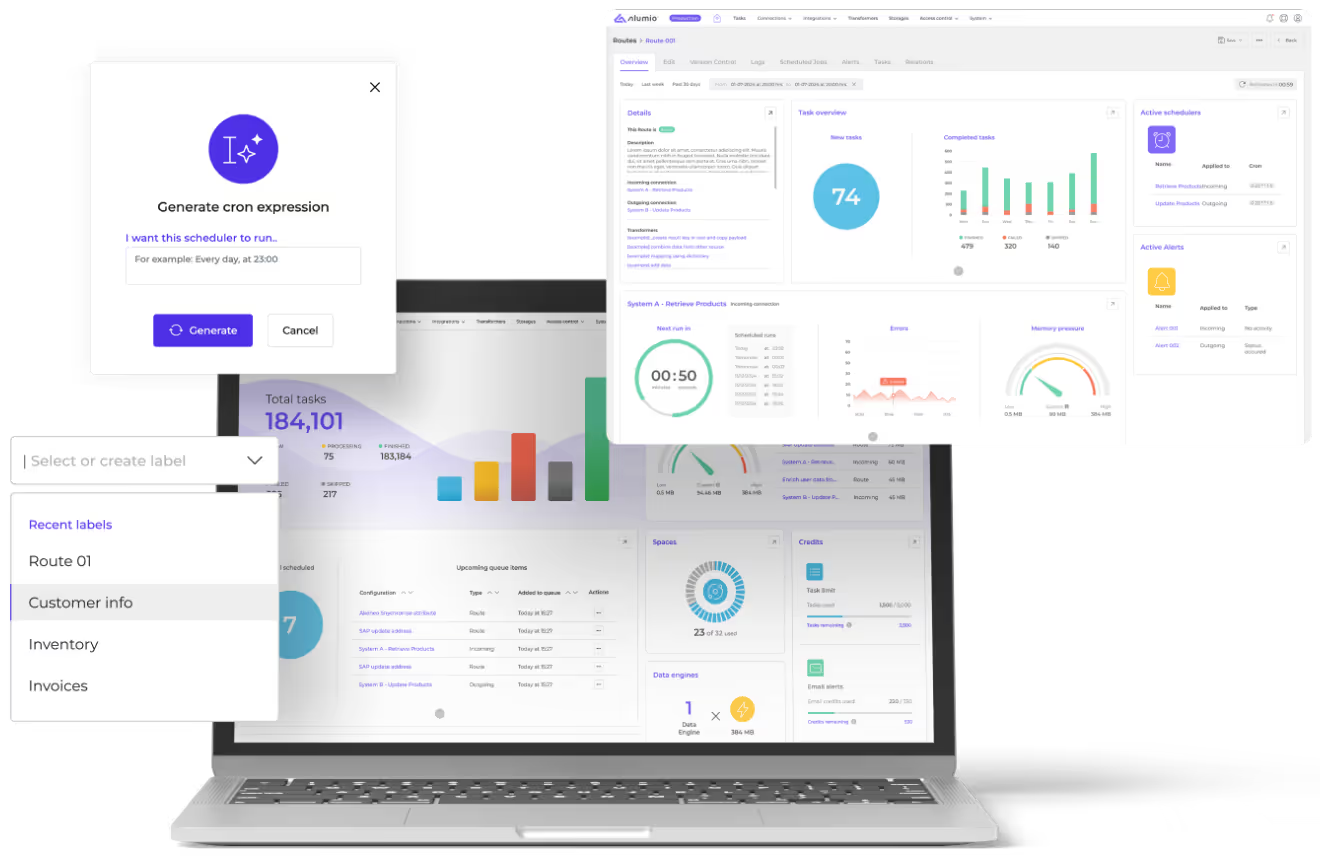
Laptop screen displaying the Alumio iPaaS dashboard, alongside pop-up windows for generating cron expressions, selecting labels and route overview.