


A Alumio vivid purple arrow pointing to the right, a visual representation of how to access more page material when clicking on it.
Gå tillbaka
iPaaS
Extern blogg
8 min läsning

De olika typerna av mellanvarulösningar jämfört med iPaaS

Av
Saad Merchant
Publicerad den
January 12, 2026
Uppdaterad den
June 26, 2026
I SAMTAL MED
Email icon
Email icon

Sedan starten av den digitala tidsåldern har företag utökat sin digitala tillväxt och de tjänster de tillhandahåller genom att integrera flera system, applikationer och datakällor. Det mest effektiva sättet att bygga dessa integrationer innebär att man använder en mellanliggande programvara som kallas middleware, som hjälper annan programvara att kommunicera, utbyta och integrera data. Under åren har företag implementerat många mellanprogramvareintegrationslösningar, till exempel Message-Orientered-Middleware (MOM), API-hantering, dataintegration, ESB (Enterprise Service Bus) och SaaS-integrationslösningar. Tillkomsten av iPaaS (integration Platform as a Service) har dock inlett en nästa generation API-driven, molnbaserad mellanprogramvara. IPaaS innehåller många aspekter av tidigare middleware-lösningar för att bygga snabbare, mer flexibla och framtidssäkra integrationer. Låt oss kort utforska de olika typerna av middleware-lösningar som uppstod under åren för applikationsintegrationer.

The different types of modern middleware integration solutions

Middleware is a piece of software that sits in the middle of other software and applications - enabling them to communicate, exchange, and integrate data. So, how does it help build data and application integrations?

The traditional way to connect different systems or applications involves using custom code to build integrations between desired endpoints. This method is time-consuming, expensive, and difficult to maintain. Thus, in this case, a middleware solution provides the ideal framework to integrate all kinds of systems.

The three modern middleware integration solutions

While businesses have used many kinds of middleware over the years, three modern integration solutions that are most relevant for next-gen system integrations are:

  1. Traditional ESB solutions
  2. SaaS integration platforms
  3. The iPaaS (integration Platform as a Service)

1. Traditional ESB solutions

ESB, or Enterprise Service Bus, is an integration architecture framework from before the advent of the cloud. It has enabled businesses to go beyond building point-to-point integrations by connecting multiple applications from one central hub. As an on-premises middleware solution, it requires the installation of hardware. It functions as a centralized communication hub that simplifies and standardizes the integration of legacy systems with various applications, services, and databases. Since ESB solutions rely heavily on on-premises footprints, older messaging, and aging document standards, they are commonly used by enterprise businesses. They also require dedicated IT teams to be trained in managing integrations via the ESB.

Read more about the key differences between the iPaaS vs. ESB: On-Premises vs. Cloud-Based Middleware ->

2. SaaS integration platforms

As the name indicates, SaaS integration solutions are a type of middleware that integrate SaaS (Software as a Service) solutions with other cloud apps or on-premises systems using APIs. They offer pre-built connectors and adapters tailored to integrate popular SaaS applications in a faster and more streamlined manner. This integration solution may be designed to integrate only specific SaaS applications, and businesses may need to upgrade their subscription to integrate more types of apps. While SaaS integration platforms are great for integrating specific apps rapidly, they may result in vendor lock-in scenarios, making it difficult for businesses to change the applications they'ved integrated.

Read more about the differences and similarities between a SaaS solution and the iPaaS ->

3. The iPaaS (integration Platform as a Service)

The iPaaS is a cloud-based, “As-a-Service” no-code or low-code middleware solution. It's an API-driven middleware that helps seamlessly integrate multiple systems, SaaS, cloud apps, or data sources. As a next-gen integration solution, it encompasses broader integration capabilities beyond just SaaS applications, including on-premises systems, databases, APIs, and IoT devices. It enables businesses to create, monitor, and manage all their software integrations and data flows from one user-friendly web interface without custom code. Centralizing and standardizing data from all connected systems on a secure cloud space, the iPaaS facilitates real-time data exchange and synchronization. It also provides flexible data transformation features and the ability to build complex workflows to automate business processes across all connected systems.

Comparing the iPaaS with ESB and SaaS middleware solutions

Like an ESB, iPaaS solutions like Alumio are capable of integrating legacy systems with specialized connectors. However, by adopting an API-first approach, the iPaaS can also connect many more systems, SaaS, cloud apps, and data sources across both on-premises and cloud environments. While integration tools like the ESB need to be operated on-premises by trained IT professionals, the iPaaS provides a cloud-based web interface that both developers and citizen users (CTOs, project managers, junior developers) can remotely collaborate on to develop, govern, and orchestrate integrations.

Certain iPaaS vendors like Alumio provide pre-built connectors for diverse systems, SaaS, and cloud apps. The Alumio iPaaS provides special API plugins to speed up integrations with popular ERPs like SAP and Microsoft Dynamics 365. Going beyond mere SaaS integration capabilities, the Alumio iPaaS provides advanced features to help businesses build their own connectors to integrate unique software or systems. Additionally, the iPaaS provides advanced data mappers and transformers that provie the flexibility to constantly customize integrations as per evolving business needs.

Read more about how businesses are automating the integration journey with the iPaaS ->

"According to reports, organizations with 1,000+ employees use 150+ SaaS applications, and those with fewer than 50 employee use an average of 16 SaaS solutions. Less than 30% of these apps are integrated."


Förvandla AI-ambition till handling

Portrait of Leonie Becher Merli, Business Development Manager at Alumio

Få en kostnadsfri bedömning av dina integrationsbehov

Portrait of Leonie Becher Merli, Business Development Manager at Alumio

A history of middleware solutions before the iPaaS

To understand modern middleware solutions like the iPaaS, ESB, and SaaS integration platforms better, it's essential to explore how middelware solutions have evolved over the years. Let's explore some of the first types of middleware developed to facilitate system integration.

Middleware solutions emerged in the 1970s and 1980s with the need to integrate databases and applications. Here are some of the middleware solutions that evolved with the various system integration challenges that changed over time:

  1. Remote Procedure Call (RPC) Middleware enables communication between distributed systems by getting processes or components to interact over a network. By abstracting the complexities of network communication, RPC middleware facilitates collaboration between systems by remotely invoking procedures and functions.
  2. Message-Oriented Middleware (MOM) enables systems and applications to communicate by sending and receiving messages. It facilitates asynchronous messaging and uses message queues or topics to ensure the delivery and consumption of messages.
  3. Data integration platforms help businesses to integrate data from different sources, formats, and systems across an organization. They typically implement Extract, Transform, Load (ETL) processes to unify data from disparate sources into one format and within one central repository.
  4. Web services middleware emerged with the advent of web service usage in the early 2000s. It enables integrations using communication protocols such as SOAP (Simple Object Access Protocol), REST (Representational State Transfer), and XML.
  5. API management platforms help create, manage, and secure Application Programming Interfaces (APIs). An API provides a standardized way for two applications or services to communicate. Thus, API management platforms help streamline how APIs are used to build integrations.
  6. Business Process Management (BPM) is a middleware that provides tools for orchestrating and automating business processes. Providing workflow engines and process automation tools, BPM helps build and monitor workflows while allowing integration with external systems.

How the iPaaS incorporates other middleware

As a next-gen solution, the iPaaS provides greater integration flexibility than the aforementioned middleware solutions. Holistic iPaaS vendors like Alumio effectively incorporate these middleware concepts within their platform features. Here’s how the Alumio iPaaS incorporates other middleware solutions:

  • The Alumio iPaaS incorporates Message-oriented-Middleware as a core component to provide reliable messaging and queueing capabilities for integrated applications and services.
  • The Alumio iPaaS provides data integration features that inolves implementing ETL (Extract, Transfer, Load) tools for data migration and helping build centralized data lakes for 360-degree insights.
  • The Alumio iPaaS provides API management features such as API gateways and automated monitoring and logging features to detect API conflicts and integration errors.
  • The Alumio iPaaS provides business process management tools such as workflow automation, data transformation, and scheduling features that help automate business processes, significantly reducing manual work and data entry.

In context to future technologies, the Alumio iPaaS provides flexible integration infrastructure to accommodate future development approaches like Composable Commerce. This involves integrating only best-of-breed components instead of complete software solutions. In other words, the Alumio iPaaS supports businesses adopting modular, composable business capabilities that can be easily assembled and reassembled to meet changing business needs.

"According to HTF Market Intelligence, the IPaaS Software market size is estimated to increase by USD 3296 Million at a CAGR of 20.6% from 2023 to 2028."

The iPaaS as a future-proof middleware solution

The integration flexibility the iPaaS offers as a middleware solution enables modern businesses to go beyond integrating sytems and software applications. Apart from Composable Commerce, it also helps integrate other emerging technologies like conversational and predictive AI technology. For instance, the Alumio iPaaS provides a connector to integrate OpenAI with e-commerce software solutions to improve business automation.

In conclusion, the iPaaS (Integration Platform as a Service) has emerged as a next-generation middleware solution that combines the strengths of traditional middleware with cloud-based flexibility. And this is what makes it ideal for enterprises to use the iPaaS as a fast, flexible, and future middleware to connect all systems and streamline real-time data exchange across the entire Value Chain.

Inga objekt hittades.
Ämnen i denna blogg:
Inga objekt hittades.

FAQ

Integration Platform-ipaas-slider-right
Vad är middleware och hur har det utvecklats till modern iPaaS?

Middleware är programvara som placeras mellan andra applikationer för att underlätta kommunikation och datautbyte. Den utvecklades från tidig meddelandeorienterad mellanprogramvara (MOM) på 1980-talet via Enterprise Service Buses (ESB) på 2000-talet till modern Integration Platform as a Service (iPaaS) i molntiden. Varje utveckling åtgärdade begränsningarna från den föregående generationen: MOM hanterade asynkron meddelandehantering men krävde lokal infrastruktur; ESB:er lade till routing och transformation men blev komplexa och dyra att driva; iPaaS erbjuder samma funktioner som en molnbaserad, prenumerationsbaserad hanterad tjänst som skalar automatiskt utan infrastrukturhantering.

Integration Platform-ipaas-slider-right
Vilka olika typer av mellanprogramlösningar finns det och när är var och en lämplig?

De huvudsakliga typerna av mellanprogramvara är: Meddelandeorienterad mellanprogramvara (MOM, t.ex. IBM MQ) för tillförlitlig asynkron meddelandehantering mellan lokala företagssystem; Enterprise Service Bus (ESB, t.ex. MuleSoft, WSO2) för komplex lokal integration med sofistikerad routing och transformation; ETL-verktyg (Talend, Informatica) för hantering av batchdatapipelines till datalager; API-hanteringsplattformar (Apigee, Kong) för styrning av API-exponering; och iPaaS (Alumio, Boomi, MuleSoft Anypoint) för molnbaserad integration av operativsystem. Rätt val beror på om det primära behovet är lokal meddelandehantering, hantering av datapipelines, API-styrning eller realtidsintegration mellan moln och moln.

Integration Platform-ipaas-slider-right
Hur står sig iPaaS i jämförelse med ESB för modern digital handelsintegration?

iPaaS är betydligt bättre lämpat för modern digital handelsintegration än ESB eftersom: molnbaserad distribution eliminerar infrastrukturkostnader (inga servrar att etablera, skala eller underhålla), förbyggda kopplingar för SaaS-plattformar (Shopify, Salesforce, Akeneo) är inbyggda snarare än att kräva anpassad adapterutveckling, distributionscykler för nya integrationer mäts i dagar snarare än månader, och prenumerationsmodellen ersätter stora initiala licenskostnader med förutsägbara driftskostnader. ESB är fortfarande relevant för organisationer med stora befintliga lokala ESB-investeringar, men för nya integrationsprojekt i moderna digitala handelssammanhang levererar iPaaS konsekvent snabbare time-to-value till lägre total ägandekostnad.

Integration Platform-ipaas-slider-right
Vilka är begränsningarna med integrationsplugins jämfört med en iPaaS?

Integrations-plugins begränsas av: det specifika användningsfall de utformades för (endast standarddataflöden täcks, anpassade krav är inte möjliga), beroende av värdplattformens lanseringscykel (plugins går sönder när plattformen uppdateras), ingen centraliserad övervakning (fel upptäcks inte), ingen transformationsflexibilitet (endast de fältmappningar som plugin-utvecklaren implementerat är tillgängliga), oförmåga att hantera flöden över flera system (plugins är punkt-till-punkt-anslutningar) och leverantörsrisk (övergivna plugins skapar säkerhetsproblem). För affärskritiska integrationer gör dessa begränsningar plugins otillräckliga oavsett deras låga initiala kostnad.

Integration Platform-ipaas-slider-right
Varför är iPaaS alltmer det föredragna mellanprogramvaruvalet för medelstora företag?

iPaaS föredras alltmer för medelstora företag eftersom det ger integrationsstyrning på företagsnivå (övervakning, revisionsloggning, versionskontroll, rollbaserad åtkomst) till organisationer som tidigare inte kunde rättfärdiga kostnaden och komplexiteten hos lokal mellanprogramvara för företag. Prenumerationsmodellen matchar medelstora företags budgetstrukturer bättre än stora ESB-licenskostnader. Förbyggda kopplingar för de SaaS-applikationer som medelstora företag kör (Shopify, HubSpot, NetSuite) är inbyggda snarare än att kräva anpassad utveckling. Och en konfigurationsbaserad arkitektur minskar den specialiserade integrationsexpertis som krävs, vilket gör plattformen tillgänglig för IT-team utan dedikerade mellanprogramvaruspecialister.

Integration Platform-ipaas-slider-right
Hur bör företag utvärdera mellanprogramvarulösningar för sina specifika integrationsbehov?

Företag bör utvärdera mellanprogramvarulösningar baserat på: täckning av anslutningar för de specifika systemen i deras landskap (inte bara allmän popularitet), anpassning av distributionsmodellen till deras infrastrukturstrategi (molnbaserade företag bör undvika lokal mellanprogramvara), hållbarhet i prissättningsmodellen vid deras förväntade datavolymer och integrationsantal, styrningskapacitet (övervakning, revisionsloggning, åtkomstkontroll), tillgången till certifierade implementeringspartners i deras bransch och region, och referenser från organisationer med jämförbara systemlandskap och integrationskomplexitet. Ett proof-of-concept på ett faktiskt användningsfall med realistiska data är mer tillförlitligt än leverantörsdemonstrationer på kurerade exempel.

Få en kostnadsfri bedömning av dina integrationsbehov

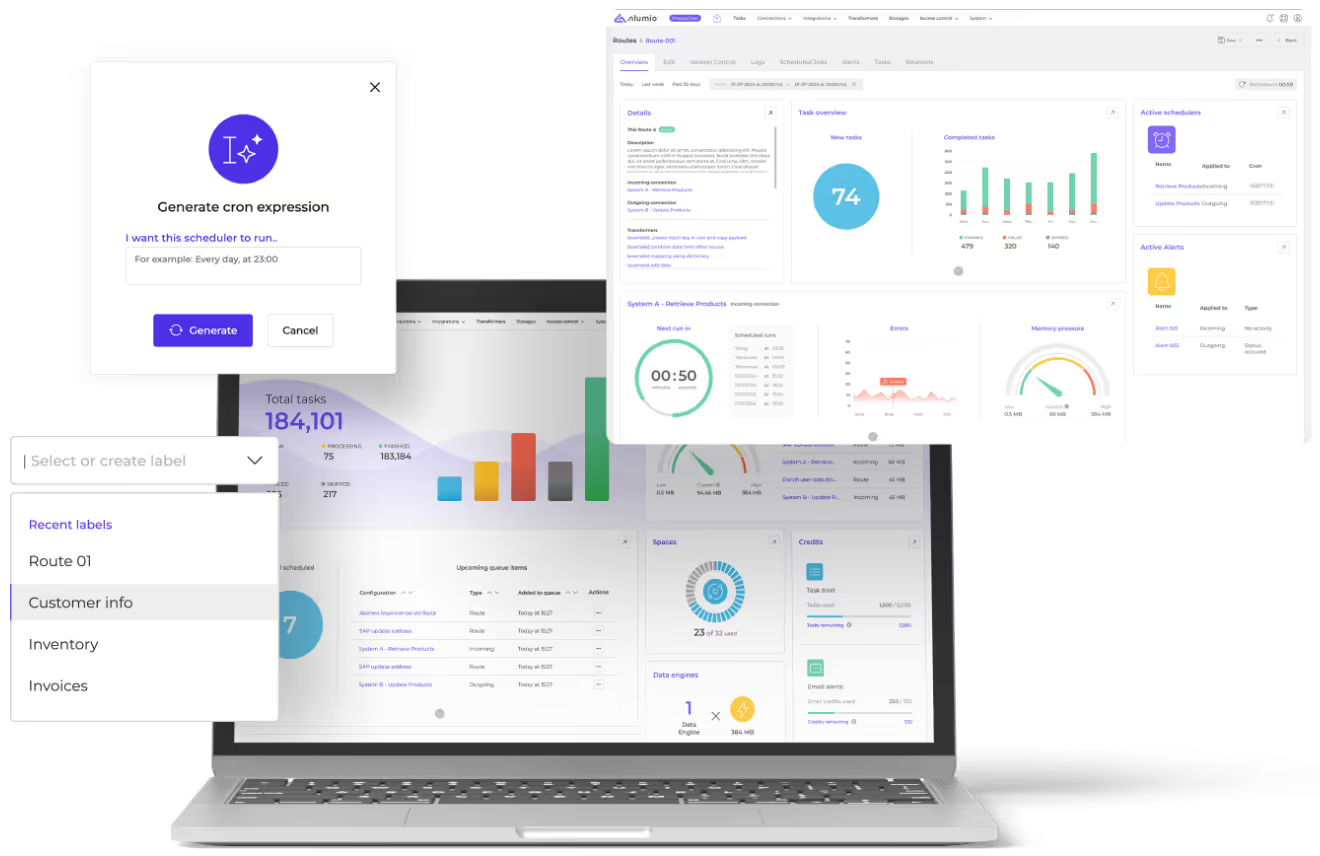
Laptop screen displaying the Alumio iPaaS dashboard, alongside pop-up windows for generating cron expressions, selecting labels and route overview.