





.svg)



The strategic benefits of an ERP and e-commerce integration
The "ERP and e-commerce integration" is one of the most common and crucial e-commerce integrations that businesses have been employing developers to build and orchestrate since the advent of the digital age. The need for implementing an ERP for e-commerce emerged from the operational inefficiencies of manual data entry, delays in order processing, difficulties in updating inventories accurately, and many other issues that resulted from these two systems being disconnected.
As a result, businesses soon realized the strategic potential of an ERP and e-commerce integration, wherein an ERP for e-commerce yielded several benefits, such as:
Efficient Data Management: Integrating data between ERP and e-commerce systems helps eliminate the need for manual data entry and reduces the risk of errors and inconsistencies.
Automated processes: Building workflows that span both ERP and e-commerce can help automate processes that can lead to increased productivity and reduced operational costs.
Holistic Business Insights: Businesses can combine and analyze customer data, product info, financial details, logistical information, and more, enabling informed decision-making.
Optimized stock levels: An ERP and e-commerce integration allows businesses to maintain optimal stock levels and ensure products are always available when needed, minimizing stockouts or overstock situations.
Improved Customer Experience: Provide customers with real-time information on inventory, order status, and shipping, leading to enhanced satisfaction and loyalty.
Read more in detail about the business benefits of an ERP and e-commerce integration →
Integrating e-commerce and ERP: best method
Over the years, agencies, system integrators, and developers have explored several methods and solutions to implement an ERP and e-commerce integration, from building custom-code integrations to using middleware solutions, all the way to now implementing API-driven integration platforms. Let's explore all these integration methods to discover what is the best method for ERP to e-commerce integration:
The limitations of point-to-point integration: custom code
Traditionally, developers have helped businesses build point-to-point ERP and e-commerce integrations with custom code. However, creating custom-coded integrations is expensive, time-consuming, and lacks scalability. For instance, if businesses wish to integrate more systems on top of the existing ERP and e-commerce integration, such as a CRM system or any of the latest SaaS (Software as Service) solutions or cloud apps, doing so with custom code is challenging, and requires extensive troubleshooting.
Moreover, governing and managing these integrations requires senior developers or professionals with coding expertise, which makes maintenance of the ERP and e-commerce integration even more expensive. This is why agencies and systems integrators resorted to middleware solutions to build integrations.
Traditional middleware solutions: ESB solutions
Among the many different types of middleware solutions for integrating systems like ERP for e-commerce, the Enterprise Service Bus (ESB) emerged as one of the first early full-fledged integration platforms. Designed for enterprise-level integration, ESB solutions are traditionally on-premises systems, which functioned as centralized communication hubs that helped enterprises integrate several disparate systems, apps, and data sources, and they all also helped facilitate data exchange between legacy ERP and e-commerce systems.
Unlike the point-to-point integration approach with custom code, ESB systems provide a more flexible architecture that allows system integrators to create easier modifications and add new integrations without disrupting the entire system. However, the plethora of new cloud apps, SaaS solutions, or e-commerce features that businesses now need to integrate in order to stay competitive, makes it challenging even for ESB solutions to keep up.
As a result, the recent introduction of API-led connectivity that powers cloud-based integration, has led developers and integrators to start using the "integration Platform as a Service (iPaaS)".
Next-gen integration platform: The iPaaS
The iPaaS (integration Platform as a Service) is a cloud-based, low-code or no-code middleware. It helps create, manage, and monitor integrations between several new SaaS solutions, cloud apps, data sources, and even legacy on-premises systems, harnessing the power of APIs.
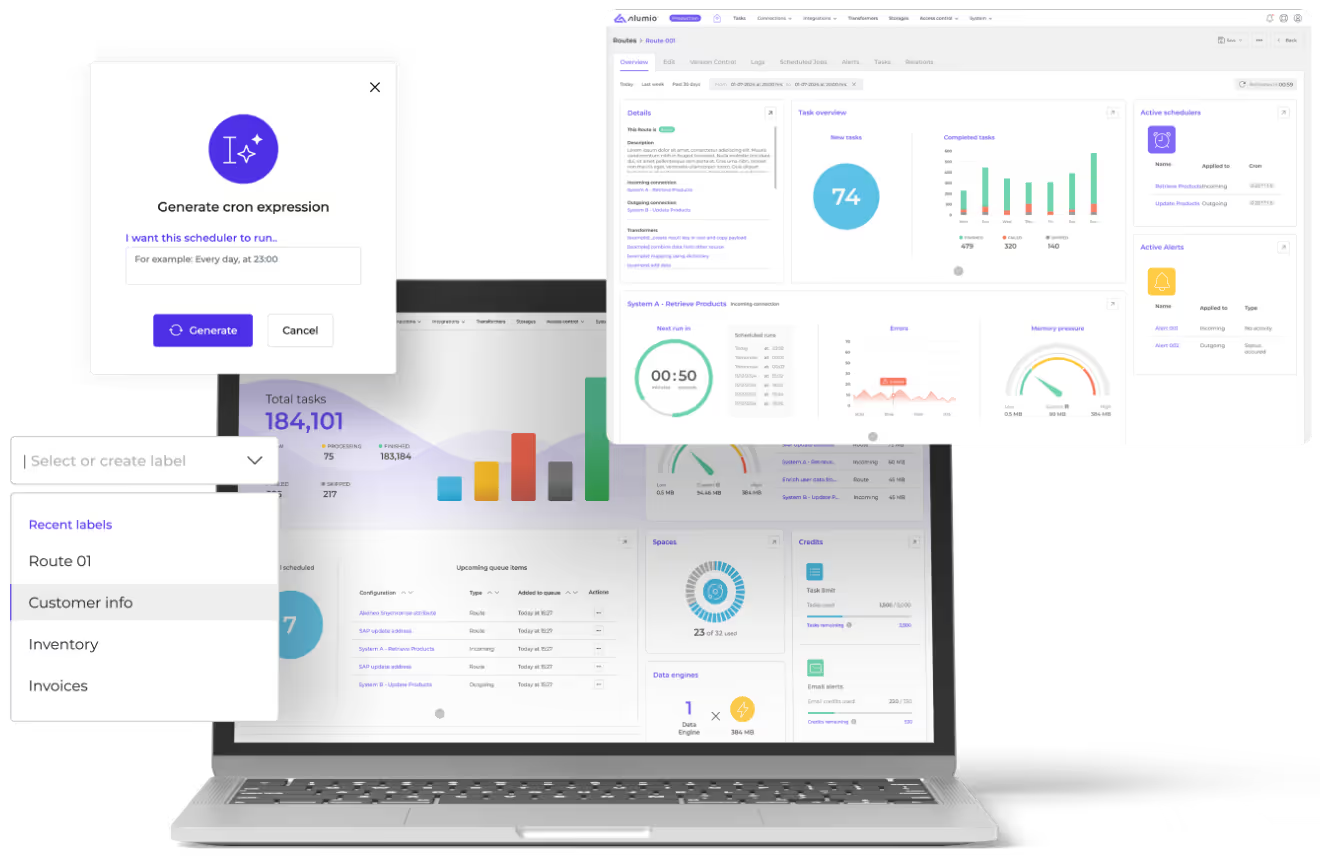
Designed to enable real-time exchange and synchronization between integrated systems, iPaaS solutions also provide a rich library of connectors that facilitate faster and seamless integrations between popular systems, such as ERP for e-commerce integrations, but also other applications such as CRM, PIM, OMS, payment gateways, marketplaces, marketing automation software, and more. Advanced iPaaS solutions like Alumio provide flexible data transformation tools and workflow builders that help facilitate process automation, which helps system integrators customize integrations limitlessly.
Most importantly, while ERP systems are designed to integrate internal processes such as operations, logistics, and finance, they aren't built to integrate seamlessly with e-commerce applications. Thus, when integrating e-commerce solutions and ERP, best practice dictates that compared to other integration methods, the iPaaS (integration Platform as a Service) provides developers with flexible tools and architecture needed to build an effective and scalable ERP and e-commerce integration.
Read more about the different types of integration platforms and methods →
How the iPaaS helps build flexible ERP and e-commerce integration
Unlike traditional integration methods, the iPaaS (integration Platform as a Service) offers better customizability, scalability, and faster deployment, making it the ideal choice for building an ERP and e-commerce integration.
Cloud-based flexibility
As a cloud-based solution, it provides system integrators with a visual web interface to develop, govern, and orchestrate data flows and automate processes between the integrated ERP and e-commerce platforms. Advanced iPaaS solutions like Alumio even enable hybrid cloud integration, wherein even on-premises ERP systems like SAP ECC can be integrated with Shopify, a cloud-based e-commerce platform, via the cloud.
Scalable growth
The iPaaS provides a scalable infrastructure that can effortlessly accommodate the evolving needs of businesses, ensuring that integration remains robust as data volumes and transaction loads increase, which is crucial for e-commerce businesses during peak sales.
User-friendly integrations
The user-friendly interfaces and intuitive tools embedded in iPaaS platforms make it accessible to both technical and non-technical users, streamlining the integration process and reducing dependency on specialized IT skills.
Integration interchangebality
The iPaaS also offers the agility and rapid deployment capabilities that businesses need to swiftly adapt to new market trends, enabling businesses to swiftly integrate new applications, features, or customizations to the existing ERP and e-commerce integration, without loss of data integrity.
However, despite all this, building ERP for e-commerce integrations is still challenging, even with an iPaaS solution. Most ERP solutions provide their own set of tools and rules, which requires heavy configuration to successfully integrate them with e-commerce apps. This is why advanced iPaaS solutions like Alumio provide specialized connectors and APIs to facilitate faster and seamless integrations with popular ERP systems.
Read more about building faster integrations with connectors →
Building faster ERP for e-commerce integrations with the Alumio ERP API Plugin
Alumio is a low-code, cloud-native iPaaS solution that's designed to facilitate faster ERP and e-commerce integrations. Popular ERP systems like SAP, Microsoft Dynamics 365, and Exact Globe lack essential B2C & D2C API points or B2B ERP software connectivity that is required to integrate them with e-commerce, PIM, CRM, and other apps. Custom building these API points is time-consuming, expensive, and error-prone.
Productizing decades of experience in integrating ERP systems, Alumio has developed unique ERP API Plugins that help install these lacking B2C or D2C API points directly within the ERP systems. Installing these necessary API points with the Alumio ERP API plugin makes it easier to integrate ERP and e-commerce solutions, enabling seamless B2C, D2C, and B2B ERP software connectivity.
Installing the Alumio ERP API plugins help drastically simplify and enhance integrations with the following systems, via the Alumio iPaaS:
Read the case study about how Pelican Products used the Alumio ERP API Plugin and iPaaS to build a complex ERP (SAP ECC) to e-commerce (Adobe Commerce) integration →
Building future-proof ERP and integration
In conclusion, building an ERP and e-commerce integration using the iPaaS is a strategic move that can help businesses grow their operations in a scalable way. It doesn't just help developers build effective ERP for e-commerce integrations, but it also provides a central cloud-based hub to build many other integrations for multiple businesses in secure digital environments. Additionally, iPaaS solutions also provide monitoring and logging features that help automatically detect integration errors or data inconsistencies.
Providing workflow automation, iPaaS solutions enable businesses to automate several processes between integrated e-commerce and ERP systems, improving operational efficiency. Most importantly, iPaaS solutions offer flexible interchangeability, which allows businesses to flexibly modify and change their integrated e-commerce or ERP vendors as they grow, and with the advent of newer solutions, without the loss of any data or data integrity.





.svg)
.svg)
.svg)
.svg)
.svg)
.svg)
