


A Alumio vivid purple arrow pointing to the right, a visual representation of how to access more page material when clicking on it.
Geh zurück
iPaaS
Externes Blog
Lesedauer: 5 Minuten

KI-gestützte Integrationsplattform 2025: Daten- und Workflow-Automatisierung in Echtzeit iPaaS

von
Veröffentlicht am
January 12, 2026
Aktualisiert am
January 15, 2026
IM GESPRÄCH MIT
Email icon
Email icon

Die Revolution der künstlichen Intelligenz kommt nicht, sie ist da und verändert jeden Aspekt der Geschäftstätigkeit von Unternehmen. Da 77% der Unternehmen KI in ihren Unternehmen entweder einsetzen oder erforschen und 83% angeben, dass KI oberste Priorität hat, lautet die Frage nicht, ob Ihr Unternehmen KI-Tools einführen wird, sondern wie effektiv Sie sie in Ihre bestehenden Abläufe integrieren werden. Hier ist die Herausforderung: KI-Tools sind nur so leistungsfähig wie ihre Fähigkeit, zusammenzuarbeiten. Eine ChatGPT-Instanz, die nicht auf Ihre Kundendaten zugreifen kann, ein maschinelles Lernmodell, das isoliert von Ihrem CRM arbeitet, oder eine KI-Analyseplattform, die keine Verbindung zu Ihren E-Commerce-Systemen herstellen kann; dies sind verpasste Gelegenheiten, die als technologische Investitionen getarnt sind. Die Lösung? Eine KI-gestützte Integrationsplattform, die Ihre Systeme nicht nur verbindet, sondern sie intelligent orchestriert, um das volle Potenzial der KI in Ihrem gesamten Geschäftsökosystem auszuschöpfen.

Why AI-powered integration platforms are essential for business success in 2025

The numbers tell a compelling story about AI's business impact. More than three-quarters of organizations now use AI in at least one business function, while Analytics Insight projects that by 2025, 80% of organizations will implement intelligent automation incorporating AI capabilities that can handle increasingly complex, judgment-based tasks.

But here's what the statistics don't reveal: the companies seeing the biggest AI returns aren't just using more AI tools; they're using them more intelligently. They've created integrated AI ecosystems where data flows seamlessly between applications, insights trigger automated actions, and every AI investment amplifies the others.

The difference between AI success and AI disappointment often comes down to integration strategy. Organizations that treat AI tools as isolated point solutions struggle to scale their impact. Those that build connected AI ecosystems through smart integration platforms are seeing transformational results.

Real-time data integration: The foundation of intelligent automation

Modern AI thrives on fresh, contextual data. Whether you're running predictive analytics, powering recommendation engines, or deploying conversational AI, the quality and timeliness of your data directly impacts AI performance. This is why real-time data integration has become non-negotiable for AI-driven businesses.

Traditional batch processing simply can't keep up with AI's appetite for current information. When your AI customer service bot can't access the latest order status, when your predictive inventory model is working with yesterday's sales data, or when your personalization engine doesn't know about recent customer interactions, you're not just missing opportunities; you're creating poor experiences that damage customer relationships.

Real-time data integration ensures your AI tools always have access to the most current information across all your systems. Customer interactions in your CRM instantly inform your marketing automation AI. Sales data immediately updates your demand forecasting models. Support tickets automatically trigger relevant AI workflows across departments.

API management platforms: The nervous system of AI ecosystems

As businesses deploy more AI tools, the complexity of managing connections between systems grows exponentially. Each AI service needs secure access to relevant data sources, the ability to trigger actions in other applications, and seamless communication with both legacy systems and modern cloud services.

This is where robust API management platforms become crucial. They provide the governance, security, and reliability needed to safely connect AI tools with business-critical systems. More importantly, they enable the kind of sophisticated AI workflows that deliver real competitive advantages.

Consider a modern e-commerce operation: AI-powered demand forecasting needs to pull data from sales systems, inventory management, and external market data sources. It then needs to trigger automated purchase orders, update marketing campaigns, and adjust pricing strategies across multiple channels. This level of orchestration requires an API management platform that can handle complex workflows while maintaining security and reliability.

Data transformation platforms: Making AI-ready data accessible

AI tools are notoriously picky about data formats. Your machine learning models expect clean, structured datasets. Your natural language processing tools need text in specific formats. Your computer vision systems require images in particular resolutions and file types.

Meanwhile, your business systems store data in dozens of different formats, structures, and schemas. Customer information lives in your CRM in one format, while the same customers appear in your e-commerce platform with different field names and data types. Product information exists in your ERP system with technical specifications, while your marketing tools need the same products described in customer-friendly language.

Data transformation platforms bridge this gap by automatically converting data between formats, cleaning inconsistencies, and enriching information as it flows between systems. This isn't just about technical compatibility; it's about ensuring your AI tools have access to the highest quality data possible, which directly impacts their performance and reliability.

Workflow automation platforms: Where AI meets action

The most powerful AI implementations don't just generate insights; they act on them. This requires workflow automation platforms that can translate AI outputs into business actions across multiple systems and departments.

Organizations nowadays are focusing on workflow automation to drive operational excellence, and the most successful implementations combine AI intelligence with automated execution. For example:

  • Fraud alert? Freeze the account. Notify relevant teams. Initiate investigation workflows
  • Negative review? Launch personalised outreach. Alert customer success team. Adjust future communications strategy.

This level of intelligent automation requires platforms that can handle complex, multi-step workflows while integrating with both AI services and traditional business applications. The goal is creating systems that think and act simultaneously, reducing the time between insight and action from hours or days to seconds.


Setzen Sie KI-Ambitionen in die Tat um

Portrait of Leonie Becher Merli, Business Development Manager at Alumio

Erhalten Sie eine kostenlose Bewertung Ihres Integrationsbedarfs

Portrait of Leonie Becher Merli, Business Development Manager at Alumio

Business process integration: Connecting AI across departments

AI's biggest impact comes not from optimizing individual tasks, but from transforming entire business processes. This requires business process integration that connects AI capabilities across departments and functions.

Take customer onboarding as an example. AI-powered document processing can extract information from forms, AI identity verification can confirm customer details, AI risk assessment can evaluate creditworthiness, and AI workflow orchestration can route approvals to the right people. But these AI tools only deliver transformational value when they're integrated into a seamless end-to-end process.

The most effective business process integration platforms don't just connect systems; they understand how AI tools fit into broader business workflows and ensure that AI capabilities enhance rather than complicate existing processes.

Application connectivity platforms: Breaking down AI silos

One of the biggest challenges in enterprise AI adoption is the tendency for different departments to deploy AI tools independently, creating isolated pockets of intelligence that can't communicate with each other. Marketing deploys AI-powered email optimization, sales implements AI lead scoring, and customer service adopts AI chatbots, but these tools operate in silos, missing opportunities for synergy.

Application connectivity platforms solve this by creating unified integration layers that allow AI tools to share insights and coordinate actions. When your sales AI identifies a high-value prospect, it can automatically inform your marketing AI to adjust campaign targeting. When your customer service AI detects satisfaction issues, it can trigger alerts in your retention AI systems. This connected approach multiplies the value of individual AI investments by enabling them to work together rather than in isolation.

Event-driven integration: Enabling intelligent responsiveness

Modern businesses operate in real-time, and their AI systems need to respond instantly to changing conditions. Event-driven integration enables this by allowing systems to react immediately to relevant events across the entire technology ecosystem.

When a customer makes a purchase, cancels a subscription, or reports a problem, these events can instantly trigger AI workflows across multiple systems. Inventory AI models can adjust forecasting, personalization engines can update recommendations, and customer success AI can modify outreach strategies; all in real-time, without human intervention.

This event-driven approach ensures that your AI systems are always working with the most current information and can respond to changing conditions faster than competitors using traditional batch-processing approaches.

The integration advantage: Why smart connectivity wins

The companies that will dominate their industries in 2025 and beyond won't necessarily be those with the most AI tools; they'll be those with the smartest AI integrations. They'll have created technology ecosystems where every AI investment amplifies the others, where insights flow seamlessly between systems, and where intelligent automation handles routine tasks while humans focus on strategic decisions.

This integration advantage comes from choosing platforms that understand both the technical requirements of AI systems and the business realities of modern organizations. The best integration platforms don't just connect systems; they enable smarter operations, faster decision-making, and more responsive customer experiences.

Alumio isn’t just another iPaaS. It’s a cloud-native, config-first platform designed to help businesses unlock the real power of AI. With:

  • Built-in API management
  • Real-time data sync
  • Data transformation
  • Workflow automation
  • Role-based access and governance
  • And more…

Building your AI-integrated future

The AI revolution is creating unprecedented opportunities for businesses that can effectively integrate these powerful new tools into their operations. But success requires more than just deploying individual AI applications; it demands a comprehensive integration strategy that connects AI capabilities across your entire technology ecosystem.

At Alumio, we understand that the future belongs to businesses that can integrate smarter, not just integrate more. Our cloud-native, config-first integration platform provides the foundation you need to connect all your AI tools and business systems into a cohesive, intelligent ecosystem. With real-time monitoring, enterprise-grade security, and the flexibility to evolve with your needs, Alumio empowers you to build the kind of integrated operations that turn AI investments into lasting competitive advantages.

Ready to transform your AI strategy from a collection of tools into an integrated intelligent system? Book a demo or schedule a consultation with us.

Keine Artikel gefunden.

FAQ

Integration Platform-ipaas-slider-right

Erhalten Sie eine kostenlose Bewertung Ihres Integrationsbedarfs

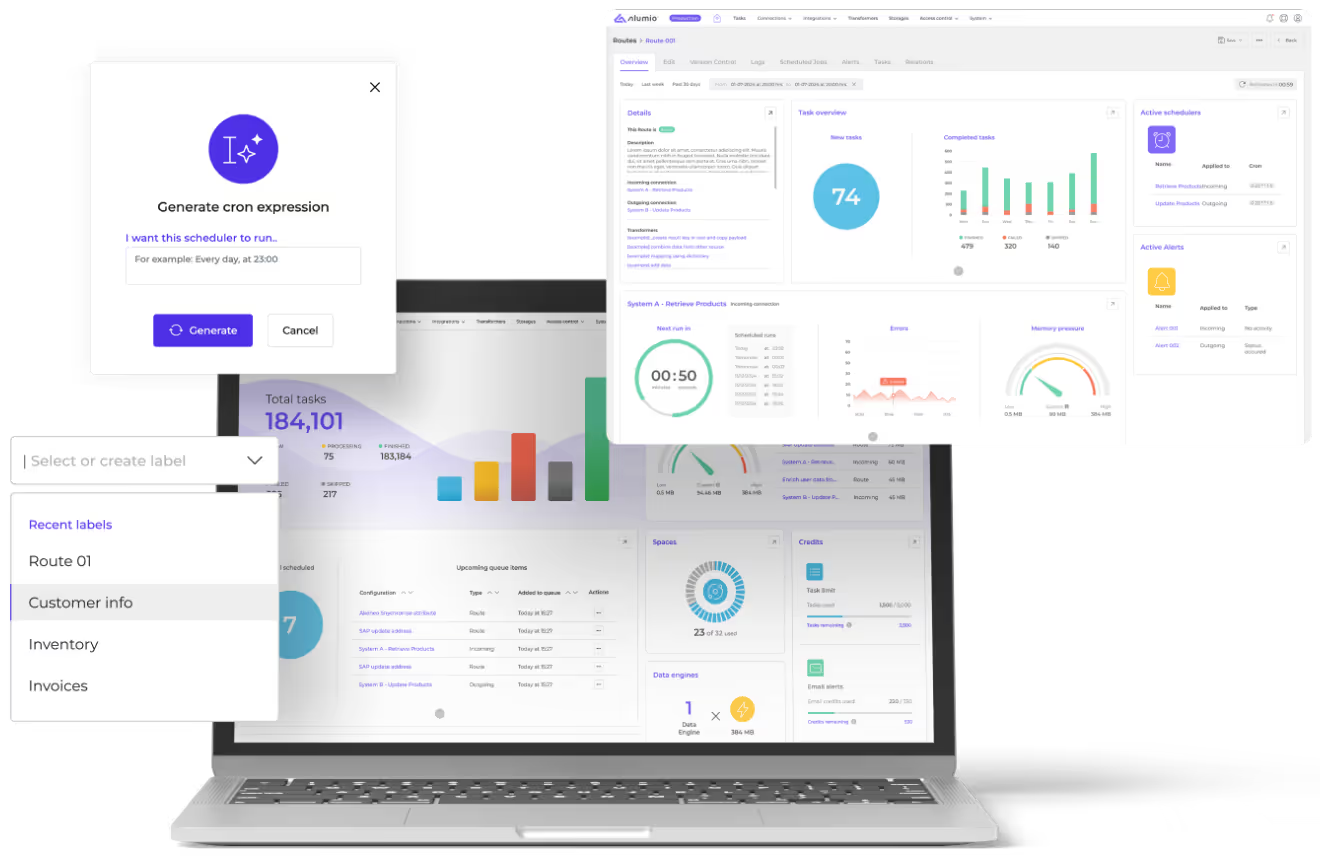
Laptop screen displaying the Alumio iPaaS dashboard, alongside pop-up windows for generating cron expressions, selecting labels and route overview.