The hidden risks of direct ERP & WMS data migration
For many organizations, the default approach to migration is a direct extraction and load process. IT teams export data from the legacy system, manipulate it in spreadsheets or staging databases, and attempt to import it into the new environment. While this method seems straightforward, it rarely accounts for the intricate dependencies between ERP and WMS data structures.
A direct migration assumes a static environment. In reality, your business does not stop just because you are upgrading software. Orders continue to flow in, inventory levels change, and shipping statuses update. Attempting a "big bang" switchover, where you turn off the old system and turn on the new one simultaneously, creates a significant risk of operational failure. If the data mapping is incorrect or if the new system rejects valid records, warehouse operations can halt entirely.
Complexity of ERP and WMS data dependencies
ERP WMS integration is notoriously difficult because these systems operate on different data models but must remain perfectly synchronized. The ERP manages financial and order data, while the WMS governs physical inventory and logistics execution.
When you migrate one or both systems, you disrupt the established logic that keeps them aligned. A product code in your legacy ERP may map to a different structure in your new cloud ERP. If your WMS migration does not account for this immediately, the warehouse cannot receive goods or ship orders because item master validation fails.
These dependencies create multiple potential failure points:
- Data format mismatches: Legacy systems may allow free-text entry where modern platforms require structured data.
- Historical data integrity issues: Migrating open orders or partial shipments requires precise state mapping that direct scripts often overlook.
- Logic discrepancies: The way a legacy system calculates "available stock" may differ fundamentally from the new platform.
A single misaligned mapping can block operations. If the new ERP rejects item master validation, goods cannot be received. If shipment state logic is incorrect, inventory discrepancies appear immediately. ERP migration and WMS migration are not just data exercises. They are synchronization redesigns.
Why downtime destroys migration ROI
The cost of downtime during an ERP migration or WMS migration often exceeds the technical costs of the project itself. For a 3PL or high-volume retailer, pausing operations for even a few days to correct data errors is unacceptable.
Traditional migration methods force organizations into operational freeze windows to ensure data consistency. The longer the migration takes, the longer the business is exposed to disruption. If errors surface during cutover, leadership faces a difficult choice: troubleshoot in real time under pressure or roll back and delay the project for months. This urgency often leads to rushed testing and technical debt embedded in the new system from day one.
How an integration platform simplifies WMS & ERP migration
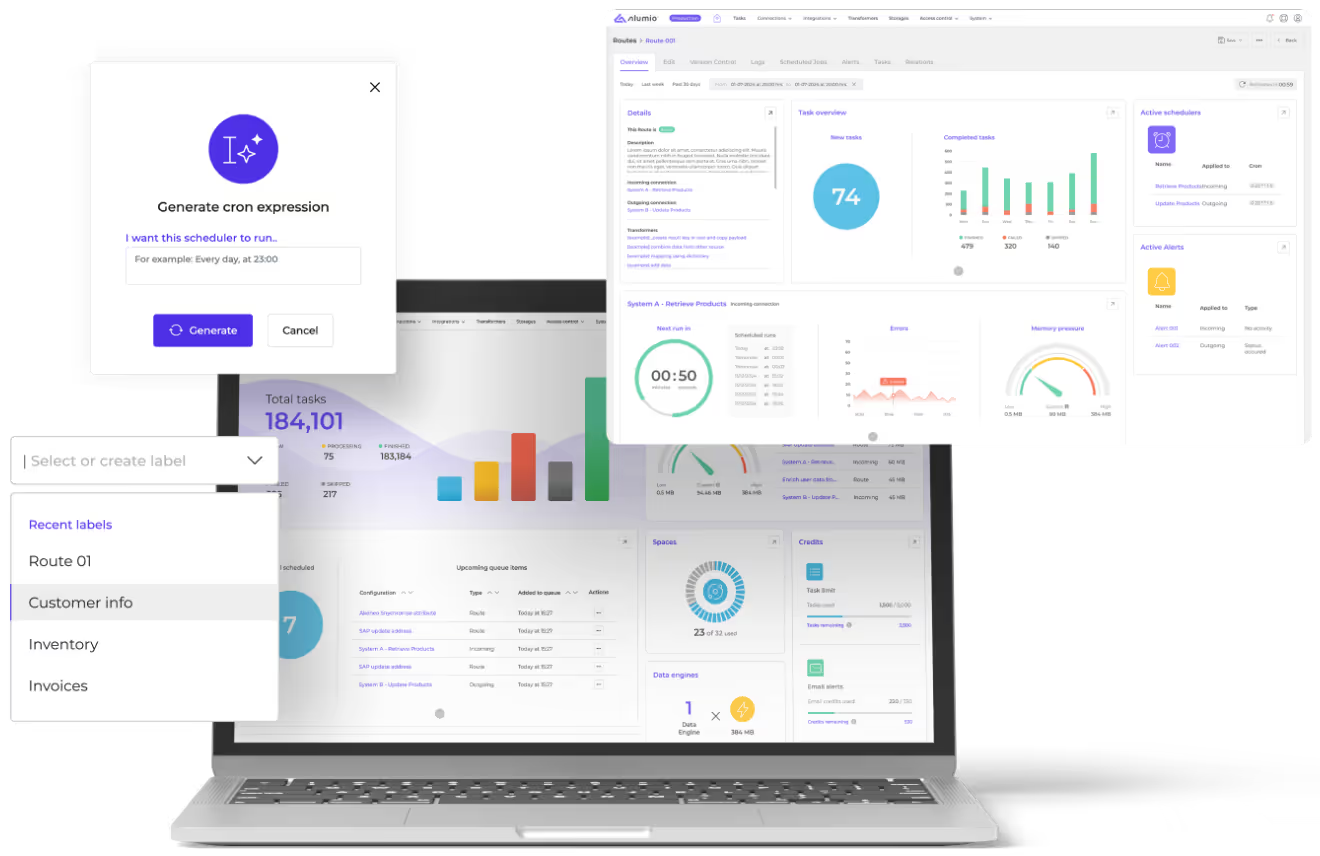
An integration platform-as-a-service (iPaaS) like Alumio, reframes migration from a one-time event into a continuous, controlled data flow. Rather than moving a snapshot of data and hoping the new system accepts it, you place the integration platform between the legacy environment and the new one, and let it act as a live translation layer for both. This architecture gives you three capabilities that direct ETL cannot provide.
Enabling phased data migration with parallel operation
An integration platform allows both systems to run simultaneously during transition. Instead of relying on a single high-risk cutover date, organizations can migrate specific business units, product lines, or regions incrementally and validate results before expanding scope.
For example, B2B wholesale orders can be processed in the new ERP while B2C e-commerce remains on the legacy system. The integration platform routes transactions according to defined business logic and ensures inventory levels remain accurate in the WMS regardless of where the order originated. If issues arise, traffic can be redirected without data loss.
This phased approach reflects how successful migrations are structured. Simpler migrations may take three to six months in phased rollout, while complex multi-system transitions may extend to twelve to eighteen months. Success comes from controlled scope, not speed.
Advanced data transformation and validation
Migrating ERP and WMS data requires transformation logic that goes well beyond field mapping. An integration platform like Alumio helps clean and enrich data in transit. It helps build structured transformation workflows data to be normalized, enriched, or validated against external services before entering the target system. Records that fail validation are quarantined for review rather than breaking the migration flow.
If the new WMS requires stricter address validation than the legacy ERP enforced, the integration platform can validate addresses against an external API during migration. Records that fail validation are quarantined for review instead of breaking the migration flow.
This prevents corrupt or inconsistent records from contaminating the new environment and improves confidence in post-migration data quality.
Delta synchronization to minimize cutover windows
A modern integration platform supports delta processing by listening for changes in the legacy system and applying them to the new environment in near real time. Once historical data such as customers, products, and past orders has been loaded, the platform continuously synchronizes new updates.
By the time you are ready to cut over, the new system is already current. The migration window shrinks significantly because you are only closing the final synchronization queue rather than transferring an entire dataset under pressure.
Automate data validation throughout the migration phase
Manual validation of millions of records is unrealistic. An integration platform enables automated comparison between source and destination systems throughout the migration lifecycle.
Monitoring alerts can trigger when record counts diverge, financial totals differ, or inventory quantities fall out of sync. This feedback loop surfaces mapping issues early, when they are easier and less costly to fix, rather than after go-live.
Reducing risk and future-proofing ERP and WMS migration
ERP and WMS migrations fail when treated as static data transfers in a live environment. They succeed when managed as controlled synchronization programs supported by a structured integration platform such as Alumio.
An integration platform enables phased rollout, centralized data mapping, automated validation, real-time delta synchronization, and rollback readiness, helping reduce downtime and protect operational continuity. Rather than relying on a single high-risk cutover window, technical leaders gain a transparent and reversible migration process. Warehouse operations continue running, data integrity remains measurable, and issues can be isolated and resolved without triggering system-wide disruption.
Most importantly, the integration platform used during migration does not disappear after go-live. It becomes the foundation of your long-term ERP and WMS integration architecture, simplifying future upgrades and enabling new applications without rebuilding brittle point-to-point connections. Migration becomes not just a system replacement, but an architectural upgrade that strengthens the business for the next phase of growth.





.svg)







.svg)
.svg)
.svg)
.svg)
.svg)
.svg)
