
What is integration, middleware, iPaaS


Course introduction
Modern businesses rely on a growing stack of internal systems, cloud applications, and SaaS tools to accelerate digital transformation and automate operations. From processing customer orders and managing inventory to handling finances and HR, nearly every business function now depends on data. Whether it’s transactions, shipping updates, customer profiles, or financial records, data fuels daily operations and drives strategic decision-making.
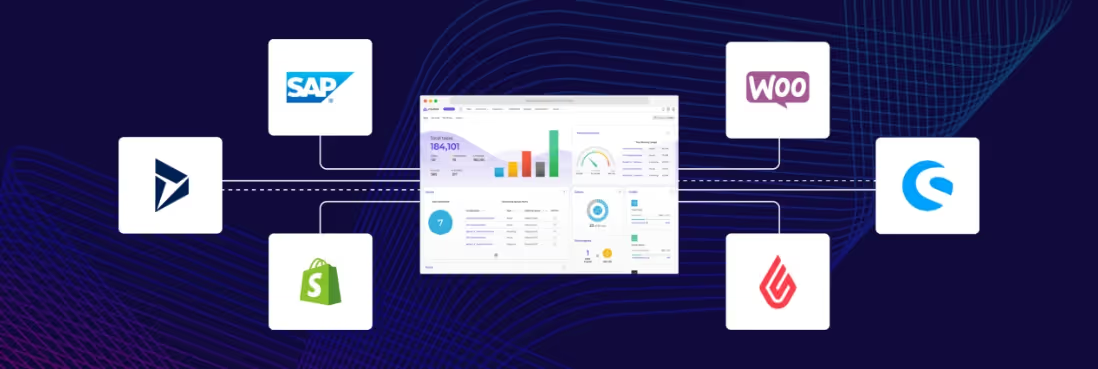
Yet, in most organizations, these data flows remain trapped in disconnected silos—generated and stored across back-end systems (like ERPs and CRMs) and third-party applications (such as e-commerce platforms, PIMs, marketing tools, and AI services). Without seamless connectivity between these systems, data remains fragmented, slowing down operations and stifling innovation.
That’s why integration is no longer optional—it’s essential for businesses aiming to scale, digitize, or adopt AI solutions. Acting as the connective tissue between applications, integration enables systems (and the data they generate) to synchronize and work in harmony—unlocking automation, real-time visibility, and sustainable growth. Yet, building integrations between applications hasn’t exactly always been simple. Not until the advent of next-gen solutions like the iPaaS (Integration Platform as a Service).
Before we dive into what the Alumio iPaaS is and how it works, it’s important to first understand what integrations are and the different ways developers have built them over the years. In this course, we’ll explore the different types of integrations, the challenges they present, and the benefits they unlock. We will also explore various middleware solutions that system integrators have used to build integrations and how they’ve evolved since the 1970s. Finally, we will touch upon how API-first middleware solutions like the Alumio iPaaS help simplify and future-proof integrations.
Note: This is one of five foundational courses in Alumio Academy designed to give you a strong conceptual understanding of integrations, how Alumio simplifies them, and how each of our platform features works. These courses will lay the groundwork for “Course 6 – Building your first integration”, where you’ll get a hands-on walkthrough of how to use Alumio to connect applications, transform data flexibly, and automate both scheduled and real-time workflows.
Lessons
- What is integration?
a. Different types of integration
b. Different integration methods
c. Key benefits of integration
d. Challenges of building integrations - What is middleware and the iPaaS?
a. The history of middleware
b. The different types of middleware - Conclusion



.svg)
.svg)
.svg)
.svg)
.svg)
.svg)
