


A Alumio vivid purple arrow pointing to the right, a visual representation of how to access more page material when clicking on it.
Go back

Alumio OpenAI Connector

By
Saad Merchant
Published on
June 4, 2025
Updated on
June 24, 2026
IN CONVERSATION WITH
Email icon
Email icon

In today’s AI-driven economy, few names resonate as strongly as OpenAI. It has transformed artificial intelligence from a futuristic concept into an everyday technology that businesses actively seek to embed across their operations. From pioneering breakthroughs in large‑scale language models to democratizing access through a robust API, OpenAI has reshaped the very landscape of artificial intelligence. For companies looking to harness OpenAI’s capabilities, integrating it into their tech stack can be a game-changer. That’s where the OpenAI Connector that the Alumio iPaaS (integration Platform as a Service) delivers comes in to play. This blog explores the business benefits of integrating OpenAI, and how Alumio’s OpenAI Connector simplifies integrating it with various business apps to drive automation.

Unlock AI automation with the Alumio Open AI Connector

As AI moves from innovation labs into the operational core of modern enterprises, its role in automating workflows, uncovering insights, and personalizing customer experiences has become mission-critical. The question facing most organizations is no longer if they should adopt AI, but how to integrate it seamlessly, securely, and at scale.

OpenAI stands at the forefront of artificial intelligence innovation, providing unprecedented access to cutting-edge AI technologies that are transforming how businesses operate. Before we delve into how the OpenAI Connector that the Alumio iPaaS provides can accelerate business automation across industries with various application integrations, let’s first understand OpenAI and the business benefits it provides.

What is OpenAI?

OpenAI is a leading artificial intelligence company known for developing advanced AI models like GPT-4, GPT-3.5, and the o-series, which power a wide range of natural language and multimodal applications. Through its API platform, OpenAI enables businesses to access cutting-edge capabilities in nuanced content creation, image interpretation, code assistance, and more, without needing to build AI models from scratch.

Founded with a mission to push the boundaries of artificial intelligence, OpenAI has gained worldwide recognition for its state-of-the-art tools. Its standout offerings include:

  • ChatGPT: A conversational AI model that has redefined how businesses engage with customers through natural language processing (NLP).
  • DALL-E: A groundbreaking tool that generates images and artwork from text descriptions, unlocking new creative possibilities.

In practice, by integrating OpenAI with their tech stack, organizations can automate customer support, generate insightful reports, create engaging content, and unlock new efficiencies, without requiring deep technical expertise. And this only scratches the surface of new possibilities in business automation. To understand this better, let's delve into the business benefits of integrating OpenAI.

Business benefits of integrating OpenAI

With over a million developers building on its API, OpenAI has become the go‑to choice for startups and Fortune 500 firms alike. Its versatility and performance have unlocked a wide range of real-world use cases that are reshaping how businesses operate, such as:

  • Intelligent chatbots: OpenAI powers chatbots that deliver personalized recommendations, resolve customer queries, and improve satisfaction by learning from interactions.
  • Content creation: Using its GPT models, OpenAI generates high-quality content for websites, blogs, and marketing campaigns. DALL-E adds another layer by producing unique visuals from text prompts.
  • Personalization: OpenAI enables recommendation engines that analyze user behavior to suggest tailored products, boosting conversions and loyalty.
  • Virtual assistants: Businesses can streamline workflows by deploying AI-powered assistants to manage tasks like scheduling or booking.
  • Automation: From website optimization to data analysis and email marketing, OpenAI automates repetitive tasks, saving time and resources.

Unlike more specialized AI tools that excel at specific, narrowly defined tasks, OpenAI's models demonstrate remarkable versatility across a wide range of applications. This flexibility allows businesses to deploy a single technology solution across multiple departments and use cases.

For instance, in e-commerce, OpenAI can also enhance inventory management by predicting demand, aggregate and contextualize customer reviews, and can generate product descriptions. These capabilities drive efficiency, reduce costs, and create seamless customer experiences. And that leads us to why integrating AI with different business apps is essential to enhance your tech stack.


Turn AI ambition into action

Portrait of Leonie Becher Merli, Business Development Manager at Alumio

Get a free assessment of your integration needs and next steps

Portrait of Leonie Becher Merli, Business Development Manager at Alumio

Accelerating OpenAI integrations with the Alumio iPaaS

While OpenAI’s potential is immense, integrating it with existing systems like e-commerce platforms, ERPs, PIMs, or CRMs, can be complex. Traditional integration methods often require extensive coding, leading to delays and errors.

The Alumio iPaaS solves this challenge by offering a low-code, cloud-native platform that connects multiple systems effortlessly. In other words, it can be used to swiftly integrate OpenAI’s capabilities with any application or data source. It can also be used to automate smart workflows to optimize and improve processes with AI capabilities, and to transform the data being exchanged flexibly.  

What is the Alumio OpenAI Connector?

The Alumio OpenAI Connector is a pre-configured integration template designed to link OpenAI with your business systems quickly, via the Alumio iPaaS. Part of Alumio’s extensive connector library, it eliminates the need for custom development, ensuring seamless data exchange between OpenAI and your tech stack.

Benefits of using Alumio's OpenAI Connector

Apart from faster deployment of integrations, using the Alumio OpenAI Connector with the Alumio iPaaS delivers powerful business and integration advantages, such as:

  • Seamless connectivity: Centralize all integrations in one platform, simplifying management and monitoring.
  • Real-time data synchronization: Keep data flowing instantly between OpenAI and other systems, critical for real-time applications like chatbots and personalization.
  • Flexibility and scalability: Customize integrations easily with a low-code interface, adapting to evolving business needs.
  • Future-proofing: Add or replace systems without disrupting workflows, ensuring long-term adaptability.

A Forrester survey found that iPaaS solutions like Alumio can cut integration time by 40%, making it a cost-effective alternative to traditional methods.

Industry use cases: integrating OpenAI via the Alumio iPaaS

By connecting OpenAI to your existing systems through the Alumio iPaaS, you unlock powerful, real-time AI capabilities without disrupting your current workflows. Here’s how using the Alumio OpenAI Connector enables seamless integration with ERPs, e-commerce platforms, PIMs, and more, can improve business automation significantly:

  • E‑commerce: Instantly generate unique, SEO‑friendly product descriptions and power 24/7 chatbots, freeing your team to focus on growth.
  • Product management: Automatically enrich and standardize product data—titles, categories, metadata—so your catalog stays accurate and searchable across every channel.
  • Marketing: Craft tailored email subject lines, social posts, and ad copy in seconds, using real customer insights to boost engagement.
  • Manufacturing: Turn raw sensor data into predictive maintenance alerts and automated work orders, cutting downtime and keeping production humming.

Starting integrating OpenAI with Alumio now

Embedding OpenAI’s cutting‑edge AI into your core processes is no longer a heavy lift, it’s a strategic advantage you can unlock in days. With the Alumio OpenAI Connector, you get a secure, cloud‑native integration that scales with your needs, provides end‑to‑end visibility, and keeps your data flowing in real time. From automating e‑commerce workflows and enriching product catalogs to predicting maintenance in manufacturing or personalizing campaigns in marketing, the Alumio iPaaS and its OpenAI Connector can help transform AI from a buzzword into business impact.

No items found.

FAQ

Integration Platform-ipaas-slider-right
What is the Alumio OpenAI connector and what does it enable?

The Alumio OpenAI connector integrates OpenAI's API into Alumio's integration Routes, enabling AI-powered processing as a step within any data flow. This means product data flowing through Alumio can be passed through an OpenAI model for automated description generation or translation, customer feedback data can be classified by sentiment, or incoming unstructured data can be structured before being written to an ERP or PIM. AI processing becomes a native capability of the integration workflow rather than a separate system.

Integration Platform-ipaas-slider-right
What business use cases does the Alumio OpenAI connector unlock?

Key use cases include: automated product description generation or enrichment (passing SKU data to OpenAI and writing the result to a PIM or e-commerce platform), content translation across locales at scale, sentiment analysis of customer reviews before routing them to CRM, automatic categorization of incoming orders or support tickets, and data normalization where unstructured text from legacy systems needs to be structured before entering modern applications. These use cases are enabled without building custom API wrappers for OpenAI in each project.

Integration Platform-ipaas-slider-right
How does embedding AI in integration flows differ from using AI as a standalone tool?

Using AI as a standalone tool requires a human to manually pass data to the AI, review the output, and apply it to the right system. Embedding AI within an integration flow via the Alumio OpenAI connector means the AI processing happens automatically as data moves between systems, at the point in the workflow where it adds the most value. The output of the AI step is immediately available for the next step in the Route, whether that is writing enriched product data to a PIM or routing a classified ticket to the right CRM queue.

Integration Platform-ipaas-slider-right
What data governance considerations apply when using AI in integration workflows?

When AI processing is embedded in integration workflows, data governance requirements include: controlling which data is sent to external AI APIs (sensitive PII should be anonymized or excluded), logging what data was processed and what outputs were produced (for auditability and compliance), and validating AI outputs before they are written to production systems (to prevent hallucinated or incorrect data corrupting ERP or PIM records). Alumio's audit logging and Transformer validation steps address these governance needs within the integration platform.

Integration Platform-ipaas-slider-right
How does the Alumio OpenAI connector support multilingual e-commerce operations?

For businesses operating across multiple languages and locales, the Alumio OpenAI connector can be used to automate translation of product descriptions, marketing copy, or customer communications as part of the data flow from PIM to locale-specific storefronts. This reduces the manual translation workload for large catalogs and ensures that new product content reaches all locale storefronts simultaneously rather than being delayed by manual translation queues. Human review of AI translations can be incorporated as an approval step before content is published.

Integration Platform-ipaas-slider-right
What should businesses consider when deciding which integration workflows to augment with AI?

The best candidates for AI augmentation in integration workflows are: tasks that involve unstructured or variable input data that traditional rule-based transformation cannot reliably handle, high-volume repetitive content tasks (translation, description generation, classification) where manual effort does not scale, and quality enhancement steps where AI enrichment adds measurable business value (better product descriptions improve conversion; accurate sentiment classification improves customer service routing). Start with a contained, high-volume use case where the output can be validated against a clear quality standard before scaling to broader AI-augmented flows.

Get a free assessment of your integration needs

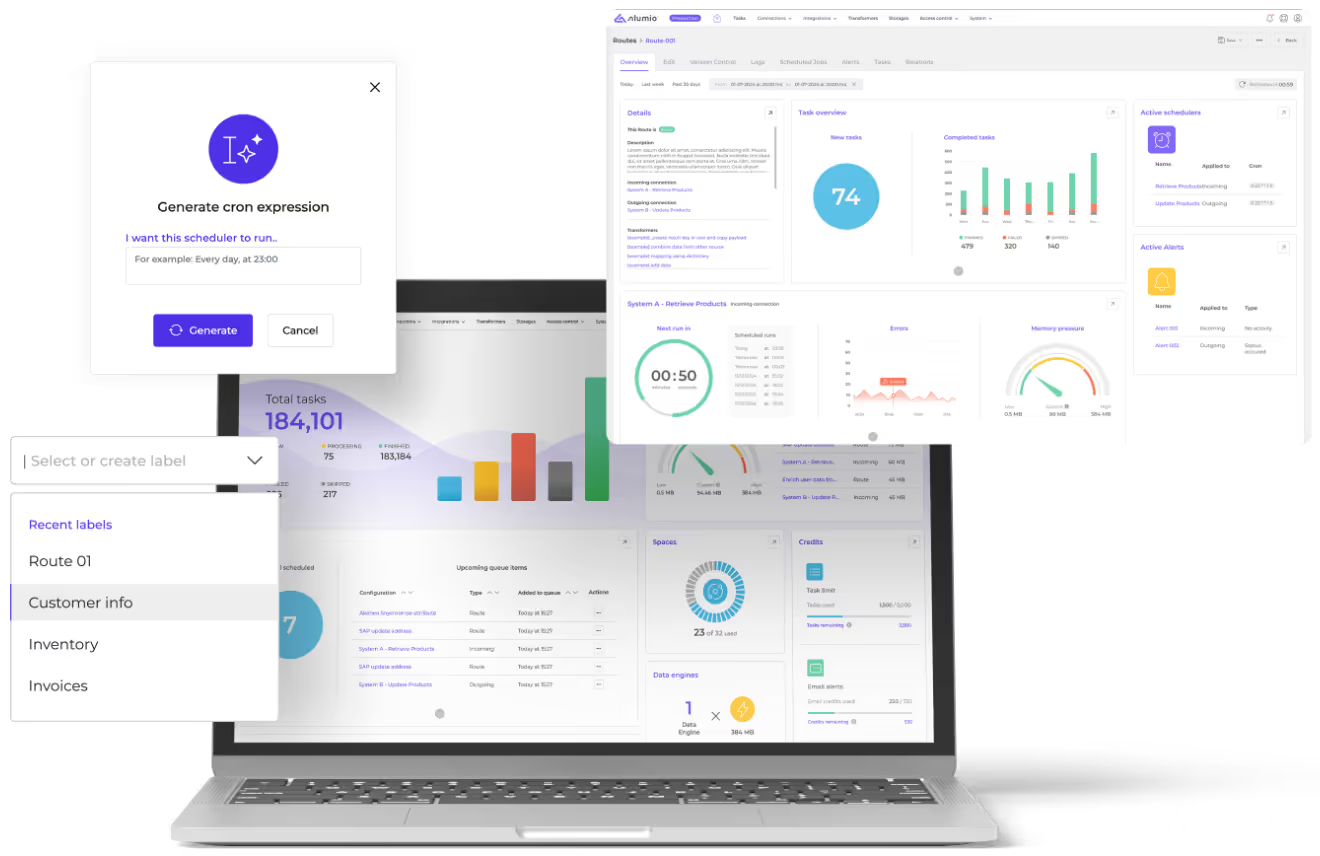
Laptop screen displaying the Alumio iPaaS dashboard, alongside pop-up windows for generating cron expressions, selecting labels and route overview.